
Credit card annual fee changes in 2026 are affecting several prominent U.S. rewards cards. Some increases were announced in 2025 but reached existing cardholders at a 2026 renewal. Others were announced in 2026, including a November change that has not yet taken effect.
This selected list covers four issuer-confirmed fee changes relevant to U.S. consumer cardholders in 2026. The Aeroplan card’s $195 price is confirmed for new applications; existing cardholders should check their account-specific notice for when it applies. This is not a complete list of all cards.
How to use this list: compare the additional fee with benefits you would use naturally. A large advertised credit total does not offset an increase when it requires new spending, restricted merchants or repeated deadline tracking.
Confirmed Credit Card Annual Fee Changes in 2026
The Platinum Card from American Express
$695 → $895 (+$200)
Existing consumer accounts opened before September 18, 2025: next renewal on or after January 2, 2026.
$550 → $795 (+$245)
For existing cardholders who applied before June 23, 2025: next account anniversary after October 26, 2025. Some paid the new fee in 2025.
Chase Air Canada Aeroplan Card
$95 → $195 (+$100)
New applications: $195 from September 10, 2026. Existing accounts: check the individual fee notice; the public announcement does not state a universal fee date.
Navy Federal Visa Signature Flagship Rewards
$49 → $95 (+$46)
Effective November 2, 2026, whether the cardholder keeps Flagship Rewards or upgrades to Flagship Premier. Check the account’s annual-fee notice for the actual billing date.
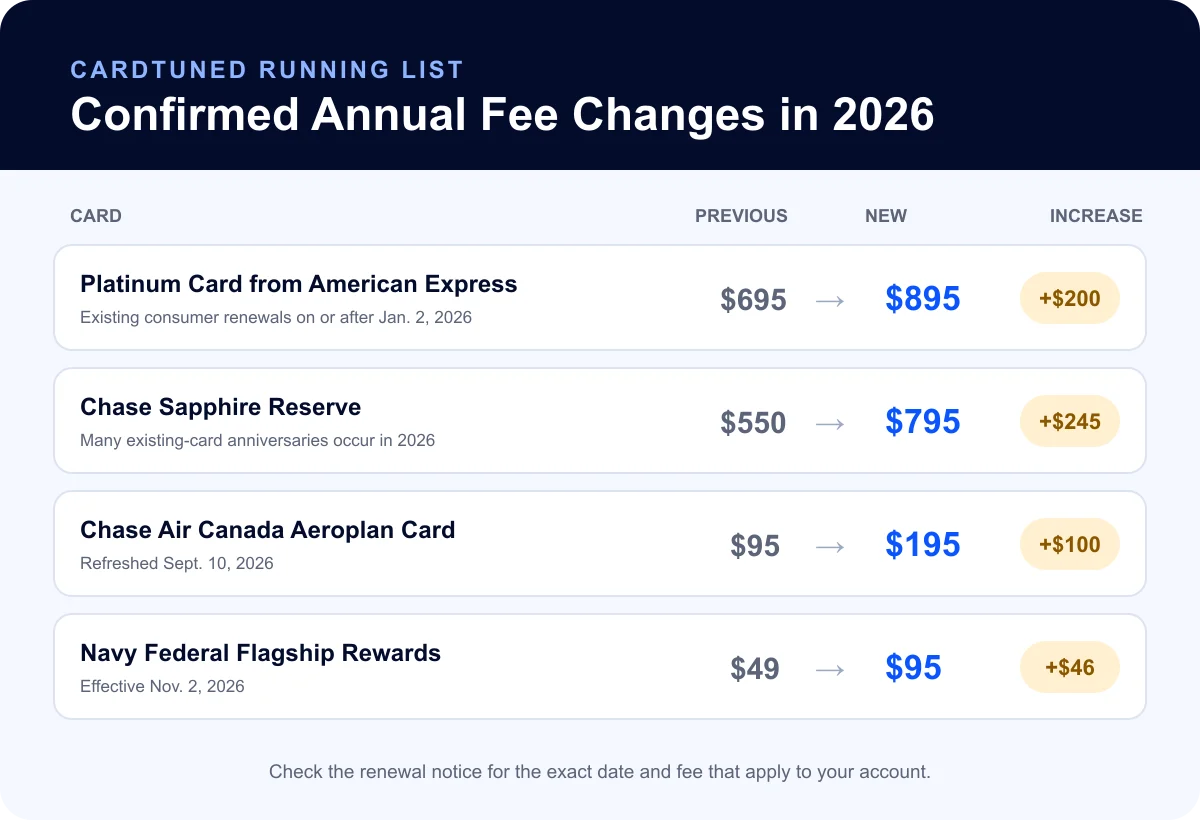
These prices alone do not answer whether each increase is worthwhile. A fee increase is only one side of the decision. The relevant question is whether the changed benefits replace spending the cardholder would otherwise make, without requiring extra purchases or inconvenient booking channels.
Platinum Card from American Express: $695 to $895
American Express announced the refreshed U.S. Consumer Platinum Card in September 2025. New accounts moved to an $895 annual fee immediately. For consumer accounts opened before September 18, 2025, American Express stated that the higher fee would take effect at the next renewal on or after January 2, 2026.
That makes the Platinum increase a 2026 event for many existing cardholders even though the announcement came in 2025.
The refreshed card expanded several benefits, including:
- up to $400 in annual Resy statement credits, divided into quarterly allowances;
- up to $300 in annual lululemon credits, divided into quarterly allowances;
- up to $600 in annual prepaid hotel credits, divided into semiannual allowances;
- up to $300 in annual digital-entertainment credits, divided monthly;
- up to $200 in annual Oura Ring statement credits;
- an Uber One membership credit, subject to terms.
The decision test
The fee increased by $200. A cardholder should therefore identify at least $200 of additional, natural value from the new or expanded benefits before treating the refresh as an improvement.
The word “natural” matters. A $100 quarterly restaurant credit is not worth $100 to someone who would not otherwise visit an eligible Resy restaurant. Likewise, a hotel credit can require an eligible prepaid booking through American Express Travel and, for The Hotel Collection, a minimum two-night stay.
Main catch
The card’s list of credits is larger, but many benefits are divided across monthly, quarterly, and semiannual periods. Enrollment is required for the Resy, lululemon, and Oura credits. Missing a period lowers the realized value, and merchant-processing delays can shift a purchase into the next period.
What to check before renewal: Review the renewal statement for the actual fee date, then look back at the prior 12 months. Count credits only when they replaced purchases you would have made anyway. If the resulting value does not cover $895, the relevant alternatives include asking American Express about available product-change options or closing the account after understanding the effect on rewards and benefits.
Chase Sapphire Reserve: $550 to $795
Chase announced the refreshed Sapphire Reserve in June 2025 with a new $795 annual fee and a $195 fee for authorized-user cards. Cardholders who applied before June 23, 2025 received the new benefits beginning October 26, 2025, with the higher annual fee charged on the next account anniversary after that date.
Cardholders whose next account anniversary falls in 2026 pay the higher fee at that anniversary; cardholders with anniversaries from October 26 through December 31 could have encountered it in 2025.
The refreshed benefits include several merchant- or channel-specific credits, such as:
- up to $500 annually for eligible prepaid two-night stays with The Edit by Chase Travel, capped at $250 per booking;
- up to $300 annually at Sapphire Reserve Exclusive Tables restaurants, divided into two six-month periods;
- up to $300 annually for qualifying StubHub and viagogo purchases, divided into two six-month periods and requiring activation;
- monthly Lyft and DoorDash benefits, subject to their individual terms.
The decision test
The fee increase is $245. The existing $300 travel credit was available before the refresh, so do not count all $300 as new value against the increase. Compare the incremental value of changed benefits and rewards with the added fee, including any authorized-user increase. Do not total every advertised credit at face value. Credits limited to select hotels, restaurants, ticket platforms, or monthly windows may be worth less than their maximum to a particular cardholder.
Main catch
Several of the new benefits require a specific merchant, booking portal, minimum stay, activation, or benefit period. The card can deliver substantial value, but it also requires more tracking than the previous version.
What to check before renewal: Confirm which version of the benefits applies to the account and when the $795 fee will post. Cardholders whose annual fee posted before the transition may have a different renewal timeline from those whose anniversary falls later in the year.
Chase Air Canada Aeroplan Card: $95 to $195
Chase and Aeroplan refreshed the U.S. Air Canada Aeroplan Card on September 10, 2026. The annual fee is now $195, up from the card’s original $95 fee.
The refreshed card added or expanded benefits that include:
- automatic Aeroplan 25K Status for the primary cardholder;
- 3 points per dollar from the card on eligible direct Air Canada purchases, plus up to 2 additional Aeroplan points on eligible flights when flying as an Aeroplan 25K member;
- 3 points per dollar on travel purchases;
- 2 points per dollar on gas, dining, and grocery-store purchases, with a limited-time 3-point rate on dining and grocery purchases through December 31, 2026;
- up to $100 in Air Canada statement credits per calendar year, split into two $50 half-year periods for qualifying direct Air Canada purchases;
- a 15% discount on eligible Air Canada flight rewards;
- a free first checked bag for the primary cardholder and up to eight companions traveling on the same reservation, subject to terms.
The decision test
The fee increased by $100. The clearest potential offset is the Air Canada credit, but receiving the full $100 requires qualifying direct purchases to post in both half-year periods. It offsets the increase at face value only when those purchases would happen anyway.
Automatic 25K Status can matter to frequent Air Canada flyers, but status should not be assigned an arbitrary cash value. Its value depends on flight frequency, routes, checked-bag needs, airport use, and whether the cardholder would otherwise qualify for status.
Main catch
The strongest benefits are tied to Air Canada and Aeroplan. A traveler who uses Aeroplan mainly for partner awards, rarely flies Air Canada, or cannot use the statement credits may see a straightforward $100 cost increase without a matching benefit.
What to check before renewal: Existing cardholders should inspect the change-in-terms notice or renewal statement for the exact date the $195 fee applies to their account. The public refresh announcement confirms the new fee and immediate benefit changes but does not replace account-specific notice.
Navy Federal Flagship Rewards: $49 to $95
Navy Federal’s official transition page states that the annual fee on the existing Visa Signature Flagship Rewards card will increase from $49 to $95 effective November 2, 2026. Check the account’s annual-fee notice for the actual billing date; the policy’s effective date is not a universal charge date for every account. The $46 increase applies whether a cardholder keeps the current product or upgrades to the new Flagship Premier card.
Navy Federal’s new Flagship Premier also carries a $95 annual fee. Its published benefits include 4 points per dollar on travel, 3 points per dollar on dining, 1 point per dollar on other eligible purchases, and a $100 annual airline credit after at least $100 in eligible airline purchases.
The existing Flagship Rewards card keeps a different earning structure and its existing benefits after the fee increase, according to Navy Federal’s transition page. That includes up to a $139 statement credit for an eligible annual Amazon Prime membership paid with the card, once per account per year; Flagship Premier replaces that benefit with a $100 airline credit after at least $100 in eligible airline purchases.
The decision test
For a cardholder who keeps the existing Flagship Rewards product, the immediate question is whether its current benefits justify paying an additional $46 each year. For a cardholder considering Flagship Premier, the decision is different: compare the new travel and dining rewards, $100 airline credit, and reduced return on non-bonus purchases with the existing product.
Main catch
Upgrading is not automatically better. Navy Federal states that Flagship Premier earns 1 point per dollar on other purchases, while the existing Flagship Rewards card earns 2 points per dollar on other eligible purchases. A cardholder with substantial non-bonus spending could give up meaningful rewards by upgrading.
Navy Federal also says that an upgrade cannot be reversed back to Flagship Rewards. That makes the decision more consequential than simply accepting the higher fee.
What to check before November 2: Compare the last 12 months of travel, dining, airline, and general spending under both earning structures. Eligible Navy Federal membership is also required; this is not a broadly available card for every U.S. consumer.
Changes Not Included in the Main List
New products are not automatically fee increases
A new card with an annual fee is not a fee increase unless an existing account is moved to it or the issuer changes the price of an existing product. This page does not classify newly launched premium cards as increases solely because their fees are high.
Surveys and rumors are not confirmed changes
Issuer surveys, online discussions, and targeted questionnaires can reveal products under consideration. They do not establish that a fee change will occur. This list adds a change only after an issuer publishes new pricing or provides a documented effective-date notice.
How to Evaluate Any Annual Fee Increase
Use the same process regardless of card:
- Identify the actual increase. Compare the old fee with the fee that will post at the next renewal.
- Separate existing value from new value. Benefits you already had do not offset the increase twice.
- Discount restricted credits. Count only credits tied to purchases you would make naturally.
- Include opportunity cost. A portal booking, premium restaurant, or prepaid hotel may cost more than the alternative.
- Review your records. Use the prior 12 months of statements rather than an idealized future plan.
- Ask about retention or product changes without assuming availability. Options can vary by account and are not guaranteed.
- Confirm the credit and rewards consequences. Ask whether a product change is available and what it would change. Inquiry treatment, account history, card number, credit limit, benefits, and rewards handling can vary by issuer and account. Confirm the terms before changing products.
- Protect rewards before closing. Understand points pooling, transfer, redemption, and certificate rules first.
The Bottom Line
The four changes covered here involve travel-oriented cards. The Amex Platinum rose by $200, Sapphire Reserve by $245, and the Air Canada Aeroplan Card by $100. Navy Federal’s Flagship Rewards increase is smaller in dollars but proportionally significant, moving from $49 to $95.
The correct response is not automatically to cancel or keep the card. Measure the additional annual fee against benefits you can use without changing normal spending. If the revised card requires new purchases, more expensive merchants, or repeated deadline tracking to break even, its advertised credit total may overstate its practical value.
If a premium card no longer clears that test, compare lower-cost alternatives in our guide to the best no-annual-fee travel credit cards before closing or changing products.
Explore these cards
Review fees, rewards and conditions, and add cards to your comparison.