This guide compares two-card systems, not individual cards in isolation. The question is whether a category specialist plus a flat-rate catch-all improves your total annual rewards enough to justify managing two accounts.
Shopping mainly online? Start with our online-shopping card guide. Choosing specifically between Amex Blue Cash Everyday and Preferred? Use the direct Amex comparison.
Quick Answer
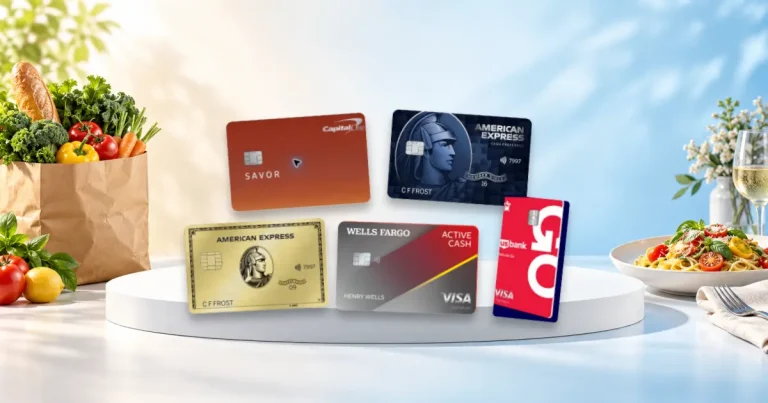
Best simple setup: Capital One Savor + Wells Fargo Active Cash
Use Capital One Savor for eligible grocery stores, dining, entertainment and popular streaming services at 3%, then use Wells Fargo Active Cash for other eligible purchases at 2%. Both cards have no annual fee.
Choose differently when: gas and U.S. online retail matter more, household bills can earn 5%, or supermarket spending is high enough to justify an annual fee.
Build the Setup in Four Steps
- Find your largest predictable categories. Review several months of spending and identify where a specialist card could add meaningful value.
- Give each card one job. Use the specialist only for its qualifying categories and the 2% card for everything else.
- Subtract caps and fees. Compare the pair with a single 2% card using your own annual spending.
- Keep the rule easy to remember. If the second card adds little value or makes payment management harder, stay with one card.
How the Best Two-Card Cash Back Setup Works
A specialist raises the reward rate on spending you can identify before checkout. The catch-all protects purchases that do not qualify, exceed a category cap or come from a merchant whose coding is uncertain. The useful comparison is not the specialist’s headline rate. It is the incremental return over a realistic one-card baseline:The comparison that matters
Incremental value = two-card rewards − one-card rewards − annual fees
1. Specialist card
Use it only for the predictable categories where it clearly beats 2%.
2. Catch-all card
Use it for everything else, including purchases above a specialist card’s cap.
Best Two-Card Cash-Back Setups
| Setup | Best for | How to use it | Fee | Est. annual rewards |
|---|---|---|---|---|
| Savor + Active Cash | Simple everyday coverage | 3% specialist; 2% catch-all | $0 | $756 |
| Blue Cash Everyday + Active Cash | Groceries, gas and U.S. online retail | 3% capped categories; 2% elsewhere | $0 | $750 |
| Cash+ + Active Cash | Utilities and connectivity bills | 5% selected categories; 2% elsewhere | $0 | $774 |
| Freedom Flex + Active Cash | Quarterly-category maximizers | 5% activated categories; 2% elsewhere | $0 | $765 |
| Blue Cash Preferred + Active Cash | High supermarket spending | 6% supermarkets/streaming; 2% elsewhere | $95 after year one | $835 net |
Best Overall for Simplicity: Capital One Savor + Wells Fargo Active Cash
Why it fits: This pair gives each card a clear job without an annual fee. Use Savor for eligible grocery stores, dining, entertainment and popular streaming services at 3%, then use Active Cash for other eligible purchases at 2%.
Best for: Households that spend regularly on food and entertainment and want one checkout rule.
Think twice if: Gas, U.S. online retail or international purchases make up more of your budget. Travelers with an eligible Fidelity account could substitute the no-foreign-transaction-fee Fidelity Rewards Visa as the catch-all.
Best No-Fee Setup for Groceries, Gas and Online Retail: Blue Cash Everyday + Active Cash
Why it fits: Blue Cash Everyday covers three common categories that Savor does not combine: U.S. supermarkets, U.S. gas stations and eligible U.S. online retail. Active Cash handles everything outside those categories and spending above a cap.
Best for: Drivers and online shoppers who also buy groceries at qualifying U.S. supermarkets.
Think twice if: Most grocery spending happens at Walmart, Target or warehouse clubs, or if you want uncapped bonus categories.
See CardTuned’s guides to online-shopping credit cards and grocery and dining credit cards for merchant-category details.
Best for Household Bills: U.S. Bank Cash+ + Active Cash
Why it fits: Cash+ can turn selected household bills into the specialist side of the wallet. Choose two 5% categories each quarter—such as home utilities, TV/internet/streaming or cell phone providers—then use Active Cash for other purchases.
Best for: Households with predictable bills that accept credit cards without a meaningful fee.
Think twice if: You do not want to select categories every quarter or your providers charge card-processing fees.
Best for Quarterly-Category Maximizers: Chase Freedom Flex + Active Cash
Why it fits: Freedom Flex rewards someone willing to adapt each quarter. It earns 5% on up to $1,500 in combined activated quarterly categories, plus 3% on dining and drugstores. Active Cash covers nonbonus spending at 2%.
Best for: Cardholders who already track quarterly categories and can redirect spending without buying more.
To track this activation cutoff alongside other card dates, see the Q4 2026 credit card deadlines.
Think twice if: You miss activation deadlines or prefer the same wallet rule throughout the year.
Best for High Supermarket Spending: Blue Cash Preferred + Active Cash
Why it fits: Blue Cash Preferred is the fee-based option for a household that can use its 6% U.S. supermarket and eligible streaming rates, plus 3% on transit and at U.S. gas stations. Active Cash covers purchases outside those categories and supermarket spending above the cap.
Best for: Households whose qualifying supermarket spending and other bonus categories offset the ongoing annual fee against their chosen one-card baseline. Use the break-even calculation below; a comparison against a no-fee 3% grocery card is a different test.
Think twice if: Your grocery spending is below the break-even point, concentrated at excluded merchants or likely to exceed the cap by a wide margin.
One Card vs. Two Cards: The Break-Even Calculation
Compare a specialist plus your existing 2% card with keeping the 2% card alone. Count only purchases that actually qualify for the specialist’s higher rate and remain below its cap.
Extra annual value = eligible spending shifted × (specialist rate − 2%) − additional annual fee.
Fee break-even spending = additional annual fee ÷ rate difference. For a target of $100 more per year, use (additional annual fee + $100) ÷ rate difference instead.
| Illustrative second card | Extra rate vs. 2% | Annual fee break-even | Spending for $100 extra net |
|---|---|---|---|
| 3% category; $0 fee | 1 percentage point | $0; any eligible spend adds rewards | $10,000/year |
| 5% category; $0 fee | 3 percentage points | $0; any eligible spend adds rewards | About $3,333.34/year |
| 6% category; $95 fee | 4 percentage points | $2,375/year (about $198/month) | $4,875/year (about $406/month) |
For example, shifting $4,000 a year from 2% to an eligible 6% category adds $160 before fees. With a $95 additional annual fee, the pair is only $65 ahead. At $2,375 of shifted spending, the extra $95 of rewards exactly offsets the fee. Your personal break-even point can be higher if managing another account takes time or causes mistakes.
Quarterly caps cannot always be pooled across the year, and spending above a cap may earn less than 2%. Use our cash-back cap guide to decide when to switch back. This comparison is against one 2% card; choosing between two different grocery cards requires the separate Blue Cash Everyday vs. Preferred comparison.
Before renewing or adding a fee-based card, check confirmed annual-fee changes and their effective dates, then rerun the calculation using the fee that applies to you.
When One Card Is Better
A one-card setup is often the smarter choice when:- the projected gain from the second card is less than roughly $50 to $100 a year;
- most spending occurs at merchants that do not fit standard bonus categories;
- you regularly miss activation deadlines;
- another account would make it harder to pay every statement balance on time;
- the second card’s annual fee depends on spending or credits you may not use.
Do You Need a Third Card?
A third card can be justified when it fills a large uncovered category—such as Amazon spending, utilities or international purchases—without duplicating the first two cards. Calculate the incremental return before applying. If the third card adds only a few dollars a month, the two-card system has probably reached its practical stopping point.Before assigning a grocery card its role, check which stores count toward its grocery category. Then use the grocery-and-dining shortlist to choose the specialist that fits that eligible portion of your budget.
Before You Apply
- Review several months of spending instead of choosing from advertised rates alone.
- Check whether your supermarkets, gas stations and online merchants use eligible category codes.
- Confirm caps, activation dates, annual fees and the current application offer.
- Do not pay a processing surcharge to earn a smaller reward.
- Pay statement balances in full when possible. Interest can erase a year of cash back quickly.
- Application approval is not guaranteed, and opening an account may involve a credit inquiry.
Which Setup Fits You?
- Want the simplest rule? Start with Savor + Active Cash.
- Spend heavily on gas and U.S. online retail? Choose Blue Cash Everyday + Active Cash.
- Can route utilities and connectivity bills? Consider Cash+ + Active Cash.
- Already track rotating categories? Freedom Flex + Active Cash can reward the extra work.
- Spend enough at qualifying U.S. supermarkets to offset a fee? Compare Blue Cash Preferred + Active Cash.
The best two-card cash back setup gives each card a distinct job. If both cards compete for the same purchases—or if the second account adds more friction than value—the wallet is not optimized. It is merely more complicated.
Methodology: CardTuned compared publicly available U.S. issuer product pages and terms, prioritizing ongoing reward coverage, caps, annual fees, category definitions, redemption and complexity. Spending examples are illustrative, and welcome offers did not determine the ongoing rankings. Review how CardTuned evaluates credit cards and the Advertiser Disclosure.Explore these cards
Review fees, rewards and conditions, and add cards to your comparison.
- Wells Fargo Active Cash Card — See card details →
- Capital One Savor Cash Rewards — See card details →
- Chase Freedom Flex — See card details →
- Blue Cash Preferred Card from American Express — See card details →
- Blue Cash Everyday Card from American Express — See card details →
- U.S. Bank Cash+ Visa Signature Card — See card details →