Getting your first credit card creates an awkward problem: lenders often want to see a credit history, but you may be applying for a card precisely because you do not have one yet.
This guide focuses on people with no established U.S. credit history, whether or not they are students. If you are enrolled in college and want to compare student-specific cards, see our college student card guide.
The first thing to know is that no credit history is not the same as bad credit. No credit usually means there is not enough information in your U.S. credit file to generate a traditional score. A thin credit file means you have some history, but not much. Bad credit is different: it reflects negative information or other factors that have already produced a low score.
That distinction changes where you should look. A first-time applicant with no established history should not automatically shop among the same fee-heavy products marketed to people rebuilding after serious credit problems.
For most people starting from scratch, the best first card is one with low recurring cost, clear issuer language about new-to-credit applicants, useful credit-bureau reporting, and a structure you can keep using after the first year. Rewards matter, but they come second.
Best First Credit Cards With No Credit History: Quick Picks
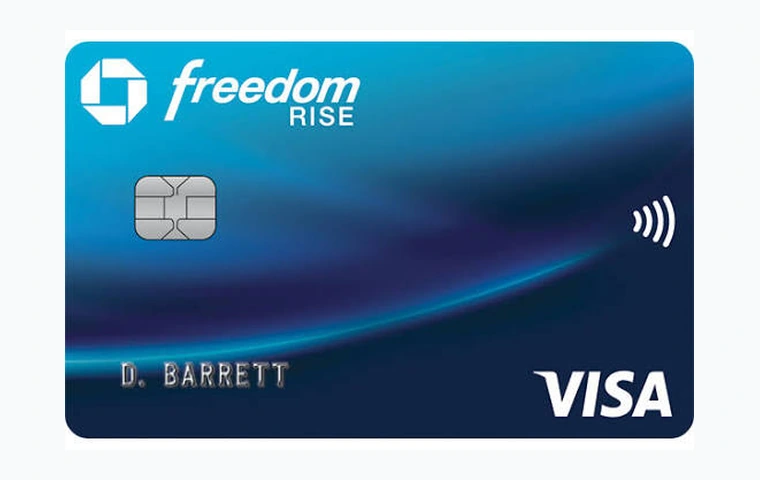
Chase Freedom Rise
Best overall unsecured starter
Discover it Secured
Best traditional secured starter
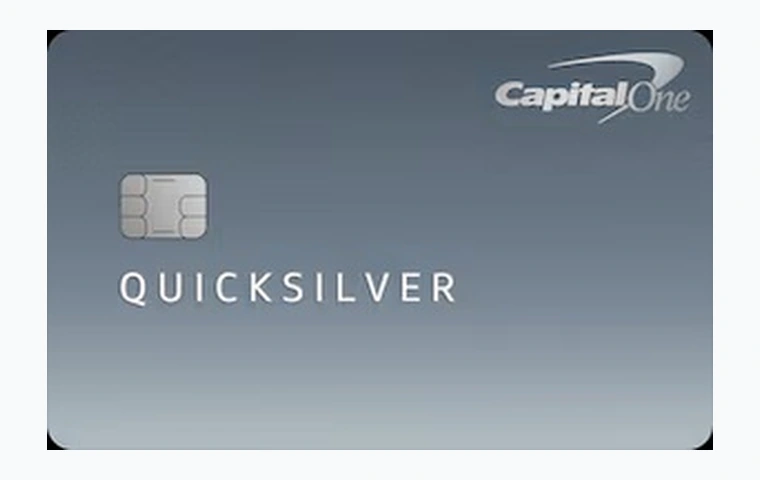
Quicksilver Secured
Best simple secured rewards
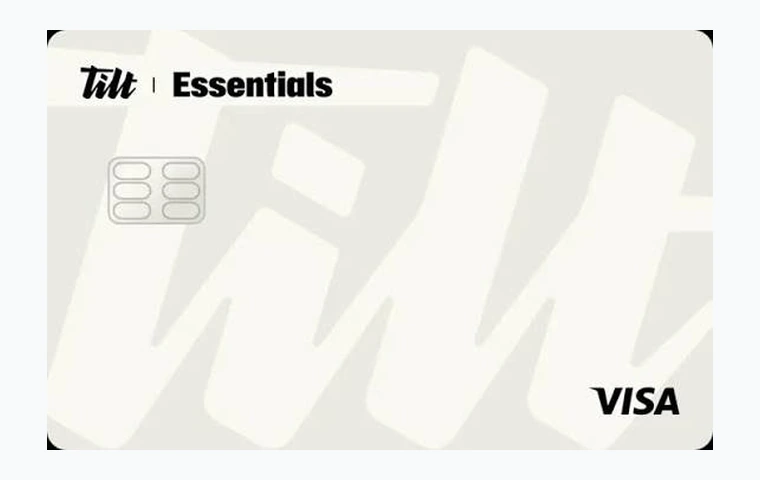
Tilt Essentials
Best alternative-underwriting path
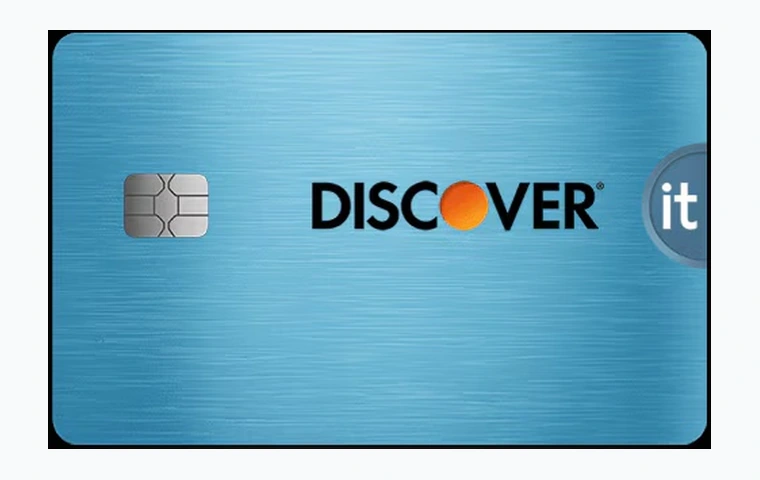
Discover it Student
Best student-only option
Chime Card
Best no-credit-check route
Six First-Card Options Compared
Card
Best for
Type
Annual fee
Main catch
Chase Freedom Rise
Best overall unsecured starter
Unsecured
$0
3% foreign transaction fee; approval still subject to underwriting
Prequalification considers you for multiple Tilt cards; exact offer matters
Discover it Student Cash Back
Best student-only option
Student unsecured
$0
Student eligibility required
Chime Card
Best no-credit-check route
Secured
$0
Chime account ecosystem required; structure differs from conventional revolving cards
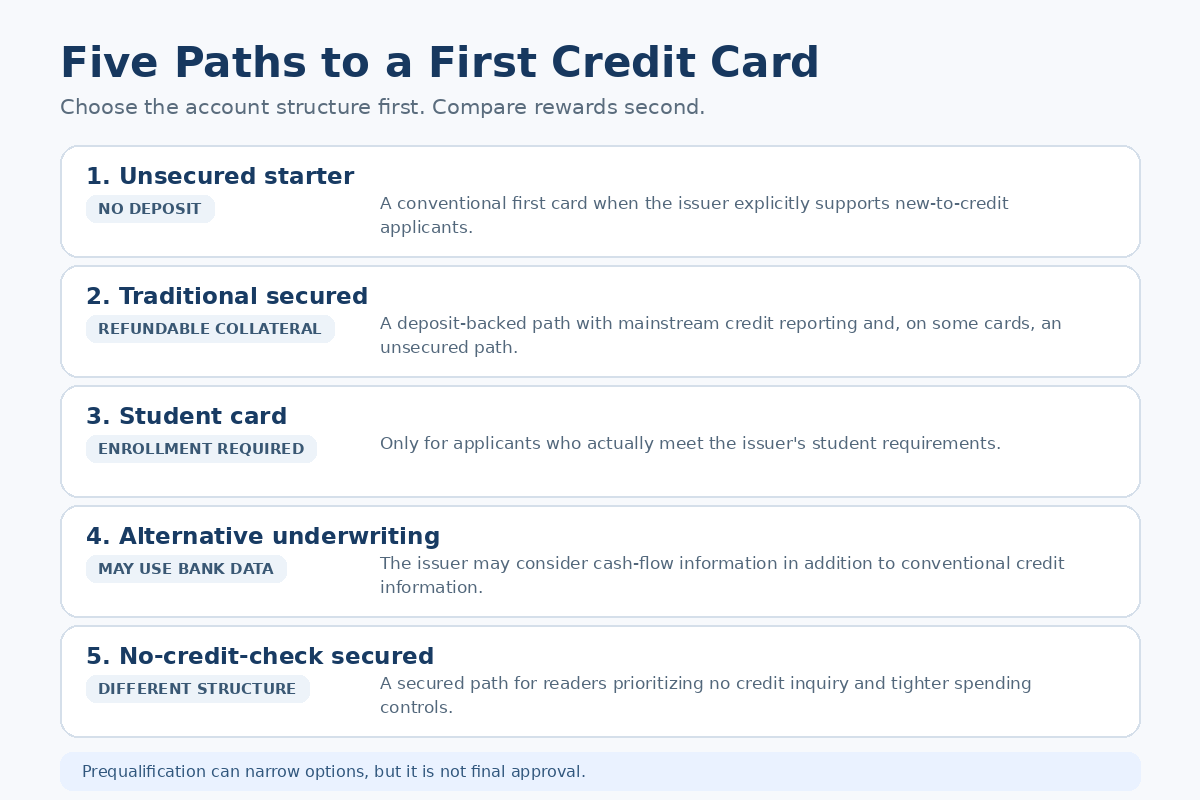
First, Choose the Right First-Card Path
Before comparing cash-back rates, decide which type of card matches your situation.
An unsecured starter card does not require collateral. When an issuer explicitly says prior credit history is not required, this can be the cleanest path if you do not want to tie up cash in a deposit.
A traditional secured card requires collateral. If the issuer calls the deposit refundable, it is not the same thing as an annual fee. The money is still tied up while the account is secured, so the amount matters to your budget even if it may later be returned.
A student card can work well if you are actually enrolled and meet the issuer’s age, income, and other requirements. It should not be treated as a general recommendation for every young adult.
Alternative underwriting means an issuer may look at information beyond a conventional credit score. Tilt, for example, says bank linking can help show real-time money habits during its prequalification process. That does not mean approval is guaranteed.
A no-credit-check secured product can avoid a credit inquiry entirely, but it may operate differently from a conventional revolving credit card.
Prequalification is not final approval
A soft inquiry generally does not affect your credit score. A full credit-card application can create a hard inquiry that may affect your score.
Some issuers let you check eligibility or prequalify first. Read the disclosure carefully: a soft-pull screening step can help narrow your options, but it is not final approval unless the issuer explicitly says otherwise.
Chase Freedom Rise — Best Overall Unsecured First Card
Why it fits: Chase explicitly positions Freedom Rise for people who are new to credit and says prior credit history is not required to qualify. That is more useful for this search than taking an ordinary rewards card with a prequalification tool and assuming it works for someone who has never had U.S. credit.
Freedom Rise has a $0 annual fee and earns 1.5% cash back on purchases. Chase is also currently advertising a limited-time 3% total cash-back rate on dining, including eligible takeout and delivery, on up to $6,000 spent during the first six months.
New cardmembers can currently earn a $25 statement credit for enrolling in automatic payments within the first three months and remaining enrolled for at least 90 consecutive days.
Chase also says Freedom Rise accounts are evaluated annually for an upgrade to Freedom Unlimited when its listed account-use and payment-history conditions are met. That is an evaluation, not a promised upgrade.
Practical example: If you put $400 per month of planned spending on the card, $4,800 × 1.5% equals $72 in base cash back over a year before any limited-time dining bonus.
Main catch: No prior credit history being required does not mean approval is guaranteed. Chase still reviews the application. Chase also says having at least $250 in eligible Chase checking or savings accounts can improve an applicant’s likelihood of approval, but that relationship is not required and still does not guarantee approval.
Freedom Rise also carries a 3% foreign transaction fee, making it a weaker choice for routine international spending.
Best for: A general first-time applicant who wants to try for an unsecured $0-annual-fee card backed by unusually clear issuer language about new-to-credit consumers.
When another card is better: If you would rather start with refundable collateral, compare the traditional secured cards below. If international use is important, Quicksilver Secured is the cleaner secured option here.
Official details:View current issuer terms →
Discover it Secured Cash Back — Best Traditional Secured Starter Card
Why it fits: Discover’s current secured-card page says no credit score is required to apply, although a score may be used if one is available. Discover temporarily paused new applications on June 2, 2026 during post-acquisition integration, but its current product page again links to a live Discover preapproval flow.
The card has a $0 annual fee. Discover currently says the required refundable deposit will be $49, $99, or $200 depending on creditworthiness, with a credit line starting at $200. You may be able to deposit more before activation for a larger line, subject to the issuer’s terms.
The card earns 5% cash back on rotating everyday categories up to the quarterly maximum when you activate, plus 1% on other purchases. New cardholders also currently receive Discover’s Cashback Match at the end of the first year.
For a first card, the exit path matters more than the headline rewards. Discover states that it reports the account to the three major credit bureaus and that a positive track record can lead to the deposit being returned and the account becoming unsecured. The deposit can also be refunded if you close the account and pay the balance in full.
Main catch: Secured does not mean guaranteed. Discover explicitly says an application can still be declined. The rotating categories also add more work than a flat-rate card.
Best for: Someone who wants a traditional secured card with a potentially low required deposit, $0 annual fee, rewards, three-bureau reporting, and a documented unsecured path.
When another card is better: Choose Quicksilver Secured if you want one straightforward cash-back rate and no foreign transaction fee instead of rotating categories.
Official details:View current issuer terms →
Capital One Quicksilver Secured Rewards — Best for Simple Flat-Rate Secured Rewards
Why it fits: Quicksilver Secured pairs a $0 annual fee with unlimited 1.5% cash back and a $200 minimum refundable security deposit.
Capital One says the account is reported to the three major credit bureaus and describes ways the deposit can be returned, including becoming eligible for an unsecured account.
Capital One also says its U.S.-issued credit cards do not charge foreign transaction fees, making this the stronger traditional secured option in this list if you expect to use your first card abroad.
At $4,800 of annual spending, its 1.5% flat rate works out to the same $72 in cash back as the Freedom Rise base-rate example. The bigger choice is whether you value an unsecured application or prefer a deposit-backed account.
Main catch: The card’s current variable purchase APR is high. The rewards are not a reason to carry debt.
Best for: Someone who can comfortably set aside a $200 refundable deposit and wants simple cash back plus no foreign transaction fee.
When another card is better: Discover Secured may require less upfront collateral for some approved applicants and offers richer rotating rewards. Chime may make more sense when avoiding a credit check is the highest priority.
Official details:View current issuer terms →
Tilt Essentials — Best Alternative-Underwriting Path
Why it fits: Petal 2 is no longer the right current recommendation for a new applicant. Petal’s own get-started page now says Petal is part of Tilt and redirects prospective applicants to prequalify for one of three Tilt cards.
Tilt Essentials is the strongest replacement for this role. Tilt says you can prequalify with no impact to your credit score and that no security deposit or credit history is required.
Tilt also says bank linking can help show your real-time money habits. That makes the path meaningfully different from a recommendation based only on a conventional credit score.
Essentials currently advertises a $0 annual membership fee, no security deposit, no foreign transaction fee, a 29.99% variable purchase APR, 1% cash back on every purchase, and 3% cash back on gas and groceries when AutoPay is on. Tilt also advertises an additional 1%–10% cash back automatically at select national and local merchants, with no enrollment required. Tilt says it reports to the major credit bureaus.
The important qualification: Tilt’s prequalification process considers applicants for all three Tilt cards. Prequalifying does not mean you will necessarily be offered Essentials. Review the exact product, fee schedule, APR, and disclosures you receive before continuing. Tilt says a full application after prequalification can involve a hard pull.
Main catch: The exact Tilt card offered matters, and the purchase APR is high enough that carrying a balance can overwhelm the value of the rewards.
Best for: A first-time applicant who wants an unsecured, no-deposit option and is comfortable with bank linking as part of an alternative-underwriting process.
When another card is better: Choose Freedom Rise if you want a more conventional starter-card application. Choose a traditional secured card if you prefer refundable collateral and a more standardized product structure.
Official details:View current issuer terms →
Discover it Student Cash Back — Best for Students, and Students Only
Why it fits: Discover’s current student-card page says no credit score is required to apply, although a score may be used if available. The card has a $0 annual fee.
It currently earns 5% cash back on rotating categories up to the quarterly maximum when activated and 1% elsewhere. Discover also offers its first-year Cashback Match. Any additional statement-credit promotion can vary by offer or application link; check the specific offer shown before applying.
The eligibility label is more important than the bonus. Discover says student-card applicants must be enrolled in school and meet applicable age and income requirements.
If you are enrolled, CardTuned’s broader Best Credit Cards for College Students guide compares additional student-focused choices.
Main catch: This is not a general young-adult card. Recent graduates and other nonstudents should use one of the general starter paths instead.
Best for: An enrolled student with little or no established U.S. credit history who wants a $0-annual-fee cash-back card.
When another card is better: Freedom Rise is the more relevant unsecured starter pick if you are not a student.
Official details:View current issuer terms →
Chime Card — Best When Avoiding a Credit Check Is the Priority
Why it fits: Chime’s current product is Chime Card™, a secured Chime Visa credit card. Chime’s older Credit Builder product is now a legacy product and is closed to new enrollment.
Chime says the current card requires no credit check to apply, no annual fee, and no interest. There is no minimum deposit requirement. Instead, money in the Chime Secured Deposit Account determines how much you can spend, and opening the card also requires a Chime Checking Account.
Chime says it reports payment activity to TransUnion, Experian, and Equifax and that credit utilization is not reported for Chime Card.
This makes Chime a distinct path for someone who wants strong spending guardrails and does not want a credit inquiry to determine access.
Main catch: Chime Card is structurally different from a conventional revolving card and depends on the Chime account ecosystem. The card itself has no annual fee or interest, but Chime says optional products or services and some out-of-network ATM or over-the-counter transactions can have fees.
CardTuned also did not find a conventional issuer-documented path from Chime Card to an unsecured Chime credit card.
Best for: Someone whose top priority is avoiding a credit check and who is comfortable using Chime’s checking-plus-secured-card structure.
When another card is better: A traditional secured card is easier to compare with mainstream credit cards and offers a more conventional credit-line structure.
Official details:View current issuer terms →
What Matters More Than the Rewards
After approval: Follow our first-week credit card setup checklist to connect your payment account, choose alerts, and confirm your first scheduled payment.
Whichever first card you choose, the way you use it matters more than squeezing out another half-percent of cash back.
Pay on time. Avoid running balances close to your limit when possible. Apply selectively instead of opening several accounts at once.
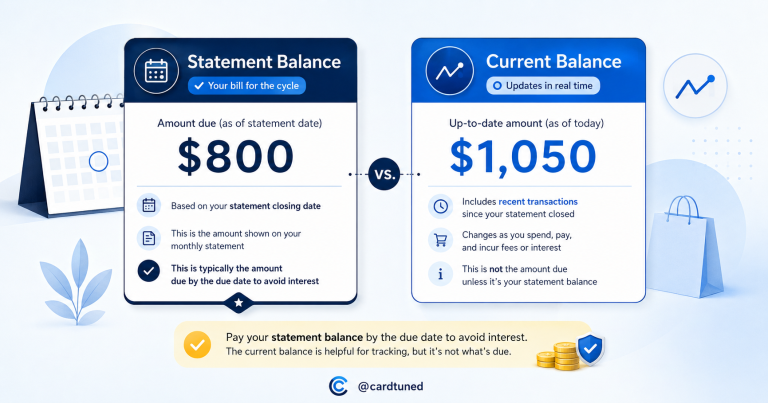
And you do not need to carry a balance or pay interest to build credit. Paying the statement balance in full by the due date can help you avoid finance charges while still creating a record of responsible account management.
Autopay can reduce the risk of an accidental late payment, but it is still worth checking every statement and making sure enough money is available in the linked account.
Check whether you truly have no credit or simply a thin file. Those situations are different from having bad credit.
Use an issuer’s eligibility or prequalification tool when the disclosure says it will not affect your score. Do not confuse screening with final approval.
Apply selectively. Several applications will not solve an income, identity, or eligibility problem.
If you choose secured, confirm the exact deposit before committing. A refundable deposit is not an annual fee, but it still ties up cash.
Read the exact product you are offered. This is especially important with Tilt, where one prequalification process can consider you for several cards.
Ignore rewards if carrying the balance would cost interest. A first card should improve your finances, not make everyday purchases more expensive.
Which First Card Should You Choose?
For a general applicant with no established U.S. credit history, Chase Freedom Rise is the first unsecured card we would examine because Chase explicitly addresses new-to-credit consumers without requiring prior credit history.
If you prefer a conventional secured route, Discover it Secured Cash Back has the strongest combination here of potentially low required collateral, rewards, bureau reporting, and an issuer-documented unsecured path.
Choose Capital One Quicksilver Secured Rewards when simple 1.5% cash back and no foreign transaction fee matter more than rotating categories.
Consider Tilt Essentials when an alternative-underwriting process and no security deposit are attractive, but proceed only if Essentials is the exact card and disclosure you are actually offered.
Choose Discover it Student Cash Back only if you meet the student requirements.
And consider Chime Card when avoiding a credit check and keeping spending tied closely to money already set aside matter more than having a conventional revolving-card structure.
The goal of your first credit card is not to win the biggest welcome offer. It is to open an account you can afford to keep, pay on time, and manage consistently while your U.S. credit history develops.
How We Chose These Cards
CardTuned reviewed cards available to U.S. consumers on August 31, 2026, prioritizing current official issuer language about new-to-credit applicants, annual fees, security deposits, credit-bureau reporting, alternative underwriting, eligibility-screening mechanics, unsecured paths, foreign transaction fees when relevant, and usefulness beyond the first year.
We removed products when their current new-applicant flow no longer supported the recommendation. That is why Petal 2 was replaced with the currently marketed Tilt Essentials card after Petal’s own get-started page redirected new applicants to Tilt. We also rechecked Discover it Secured after its earlier-2026 application pause and found the current Discover product page linking to a live preapproval flow.
Read our credit card evaluation methodology, Editorial Policy, and Advertiser Disclosure.
Explore these cards
Review fees, rewards and conditions, and add cards to your comparison.
Learn what income you can put on a credit card application, including salary, spouse income, student income, freelance earnings, benefits, and under-21…
Statement balance vs current balance explained: which amount to pay, how minimum payments differ, when current balance matters, and the grace-period exceptions…