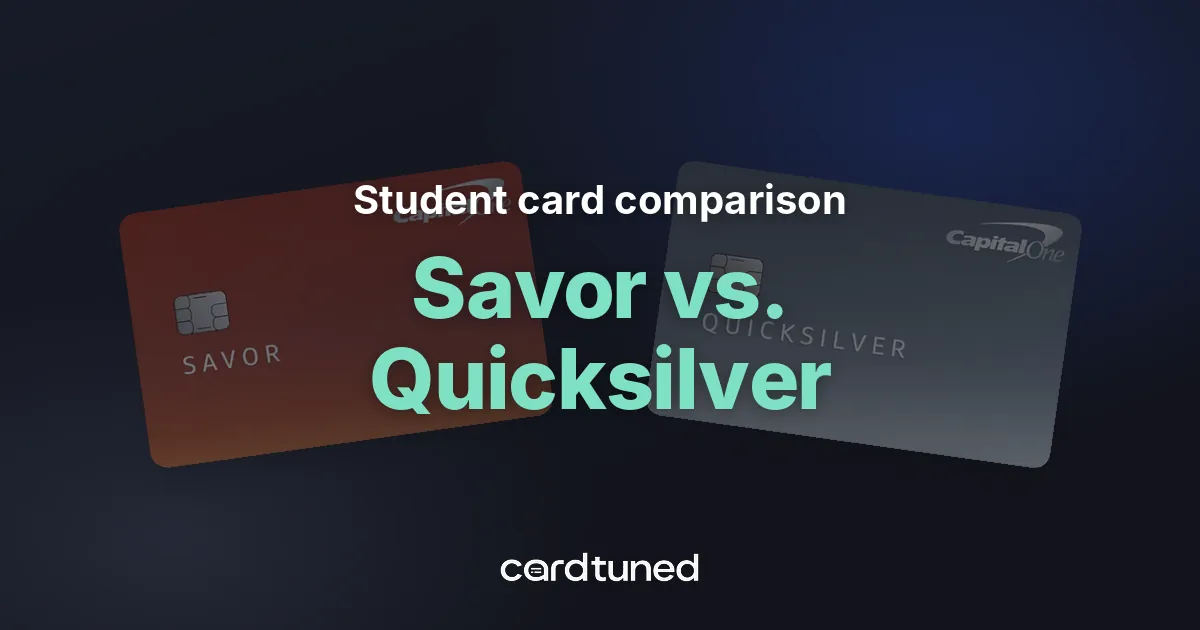
Comparing Savor Student vs. Quicksilver Student starts with the spending in your college budget. Your biggest expense may be rent, but that does not mean it belongs in a credit-card rewards comparison. Start with purchases you can actually charge without an extra fee. Then ask how much goes to restaurants, eligible groceries, entertainment, and streaming.
What changes between the two cards?
| Feature | Savor Student | Quicksilver Student |
|---|---|---|
| Everyday return | 3% on eligible dining, groceries, entertainment, and popular streaming; 1% otherwise | 1.5% on purchases |
| Annual fee / foreign transaction fee | $0 / $0 | $0 / $0 |
| Main catch | Superstores such as Walmart and Target do not qualify for the grocery bonus | A flat rate gives up extra rewards on Savor’s eligible 3% categories |
On a small screen, swipe across the table to see every column.
The category definitions matter as much as the headline rate. A grocery run at a superstore can earn the base rate, and a food purchase inside another business may not code as dining. The merchant and transaction data determine the category, not what you intended to buy.[1][2]
Two college budgets, with the same $800 monthly spending
These hypothetical budgets include only fee-free card purchases. They exclude tuition, rent, cash advances, welcome bonuses, travel portals, and event-booking offers. Assume every purchase listed in the bonus bucket qualifies and all balances are paid in full.
| Monthly budget | Savor Student | Quicksilver Student |
|---|---|---|
| $400 in eligible 3% categories + $400 elsewhere | $12 + $4 = $16 | $800 × 1.5% = $12 |
| $150 in eligible 3% categories + $650 elsewhere | $4.50 + $6.50 = $11 | $800 × 1.5% = $12 |
On a small screen, swipe across the table to see every column.
In the first budget, Savor produces $192 a year versus $144: a $48 advantage. In the second, Quicksilver produces $144 versus $132: a $12 advantage. The difference is useful, but too small to justify extra spending or even modest interest charges.
Why the break-even point is 25%
- Add up fee-free purchases
Use a normal month, not a semester with unusual moving expenses. - Find the eligible 3% share
Divide qualifying Savor bonus purchases by all purchases in the comparison. - Compare with 25%
At exactly 25%, Savor’s blended rate is 1.5%: (25% × 3%) + (75% × 1%). Above that share, Savor leads.
For an $800 month, the break-even amount is $200 in eligible bonus purchases. Do not put an entire supermarket budget in that bucket until you check where you shop. Reclassifying $100 from a 3% purchase to a 1% purchase reduces Savor rewards by $2.
When this comparison needs an adjustment
Both cards advertise enhanced rewards on eligible bookings through Capital One Travel, and their Capital One Entertainment rates differ. If you regularly use those channels, calculate them separately using the current offer and the actual booking price. A higher earning rate is not a saving if the same acceptable booking costs more.[3]
Neither the advertised rewards nor student status guarantees approval. Capital One’s student eligibility description includes people currently enrolled, or admitted and planning to enroll within three months, at an eligible higher-education institution. That is a product eligibility rule, not a promise of acceptance.[1]
Which one fits your actual habits?
Choose Savor Student when meals, qualifying grocery stores, entertainment, and streaming reliably exceed the threshold and you are comfortable checking categories. Choose Quicksilver Student when your purchases are scattered, most groceries come from excluded superstores, or a flat rate is easier to follow.
If you already have one, estimate the annual difference before applying for another account. In our lower-bonus budget, switching changes rewards by only $12 a year. Keeping a manageable account can be the more practical choice.
For a wider shortlist, see our student credit-card guide. If this would be your first account, first work out a payment routine that lets you pay the statement balance in full.
Sources and verification
Terms checked October 17, 2026. Offers and account terms can change. Examples labeled hypothetical are calculations, not product offers.