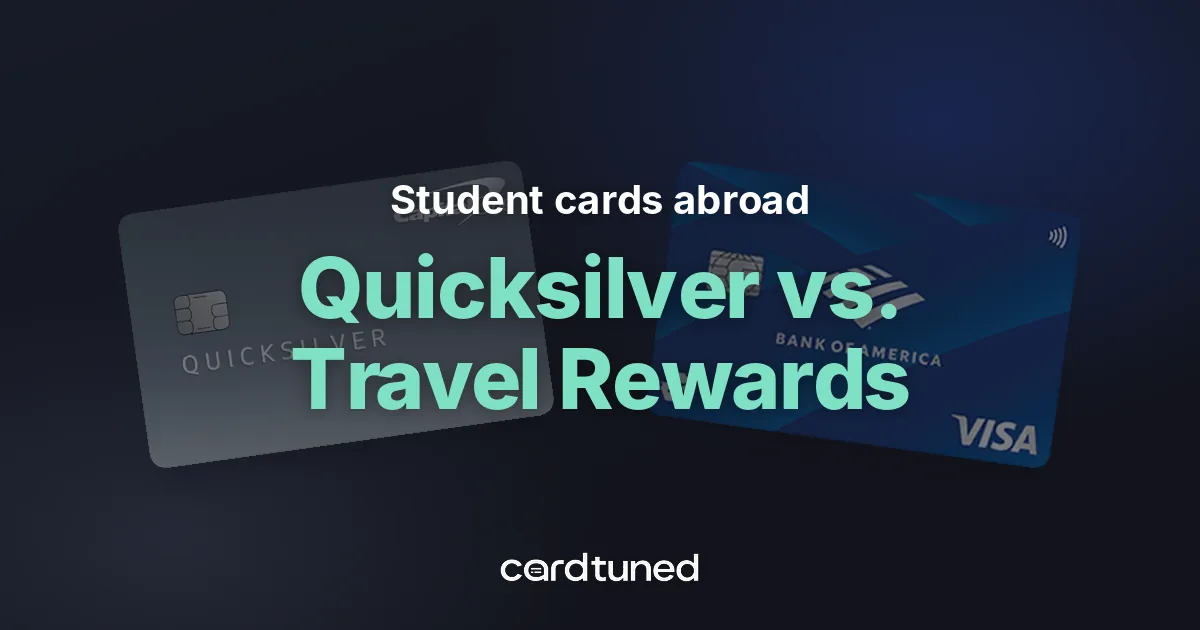
Comparing Quicksilver Student vs BofA Travel Rewards Student for a semester abroad? Both cards promise rewards without an annual fee. After you pay for groceries, train tickets and weekend trips, can you use the rewards without changing how you spend?
Both have no foreign transaction fee. That shared benefit does not make either card immune to a merchant’s currency-conversion markup.
| Factor | Quicksilver Student | BofA Travel Rewards Student |
|---|---|---|
| Annual fee / foreign transaction fee | $0 / $0 | $0 / $0 |
| Ordinary purchases | Unlimited 1.5% cash back | Unlimited 1.5 points per $1 |
| Using rewards | Cash back redeemable in any amount | Statement credits against eligible travel and dining purchases; check redemption rules |
| Main tradeoff | A flat rate may miss better category rewards elsewhere | Points require a suitable redemption; do not assume every redemption equals cash back |
On a small screen, swipe across the table to see every column.
Source: Capital One: Quicksilver Student and Bank of America: Travel Rewards for Students. The comparison uses base rewards, without any BofA relationship-program bonus.
Quicksilver Student vs BofA: the same $3,000 semester budget
Hypothetical inputs: $3,000 in ordinary eligible purchases, measured in the dollar amounts posted to the account. No portal bookings, returns, interest, fees, welcome bonuses or relationship bonuses. Assume enough qualifying travel or dining purchases and satisfaction of the redemption rules to use all BofA points at 1 cent each.
Quicksilver: $3,000 × 1.5% = $45 cash back.
BofA: $3,000 × 1.5 = 4,500 points. At 1 cent per point toward eligible purchases, that is $45 in statement credits.
The base-rate result is a tie under these assumptions. The practical difference is how you redeem it.
If you redeem the example’s 4,500 BofA points for cash at 0.6 cent each instead, the result is $27, compared with Quicksilver’s $45. The $18 difference comes from redemption value, not the earning rate.
BofA’s published Travel Rewards program information sets a 2,500-point redemption minimum for travel credits and values those points at 1 cent each. Eligible travel and dining purchases must have occurred within the previous 12 months; the rules limit the selection to the most recent 2,500 qualifying purchases. Cash redemption has a lower value of 0.6 cent per point. Confirm the program rules supplied with your student account. Source: Bank of America, Travel Rewards Program Information, footnote 13.
Compare the welcome offers separately
The reviewed Quicksilver offer is $50 after $100 in purchases within three months of opening; its terms exclude customers who received this product’s new-cardmember bonus in the past 48 months. BofA advertises 25,000 points after $1,000 in purchases within 90 days, worth $250 toward qualifying travel and dining charges. Apply through the relevant offer page and confirm your eligibility. These are one-time offers, not recurring annual rewards. Sources: Capital One: Quicksilver Student; Bank of America: Travel Rewards for Students.
A larger bonus is useful only if normal spending reaches the requirement and you can use the reward. Do not add a $1,000 purchase to a tight student budget merely to earn points. Avoid adding either bonus to the semester example unless the actual purchase dates and eligibility meet its terms.
Travel rewards do not require every booking to use a portal
Quicksilver Student offers 5% on eligible hotels, vacation rentals, rental cars and activities booked through Capital One Travel. BofA’s student listing advertises 3 points per dollar on travel booked through BofA Travel. These elevated rates depend on the booking channel; an ordinary train ticket or direct hotel payment does not automatically earn them. Sources: Capital One: Student card benefits; Bank of America: Student cards.
Compare the final price, cancellation terms and who handles a change before choosing a booking channel. A higher rewards rate cannot rescue a booking that costs more than the extra reward is worth. BofA also allows eligible travel and dining charges booked outside its portal to be offset with points; earning a portal bonus and redeeming points are separate questions.
Choose by your next semester, not the card’s name
- Choose Quicksilver for simple everyday rewards you can redeem without matching them to travel or dining charges. Its main limitation is the modest flat base rate.
- Choose BofA when qualifying purchases make the statement-credit approach useful and its offer fits your existing budget. Its main limitation is redemption friction, not an overseas transaction fee.
- Keep your current card if it already meets your overseas needs and a new account would add little usable value. Neither card is a reason to borrow for optional travel.
These are U.S. card products for applicants who meet the issuer’s requirements; being a student overseas does not by itself establish eligibility. Carry a separate backup payment method and choose the local currency when a terminal offers to convert the bill into dollars. Visa: Dynamic currency conversion explains why that conversion is a separate decision.
For what happens at the terminal and after a purchase, use our student-card abroad guide to currency choices, holds and declined payments.
For application requirements and other options, start with our student credit card guide. Choose a card before departure, then check its current rates, fees and offer through the issuer.
Sources checked October 13, 2026. Offer and account terms can change. All spending and currency examples are hypothetical.