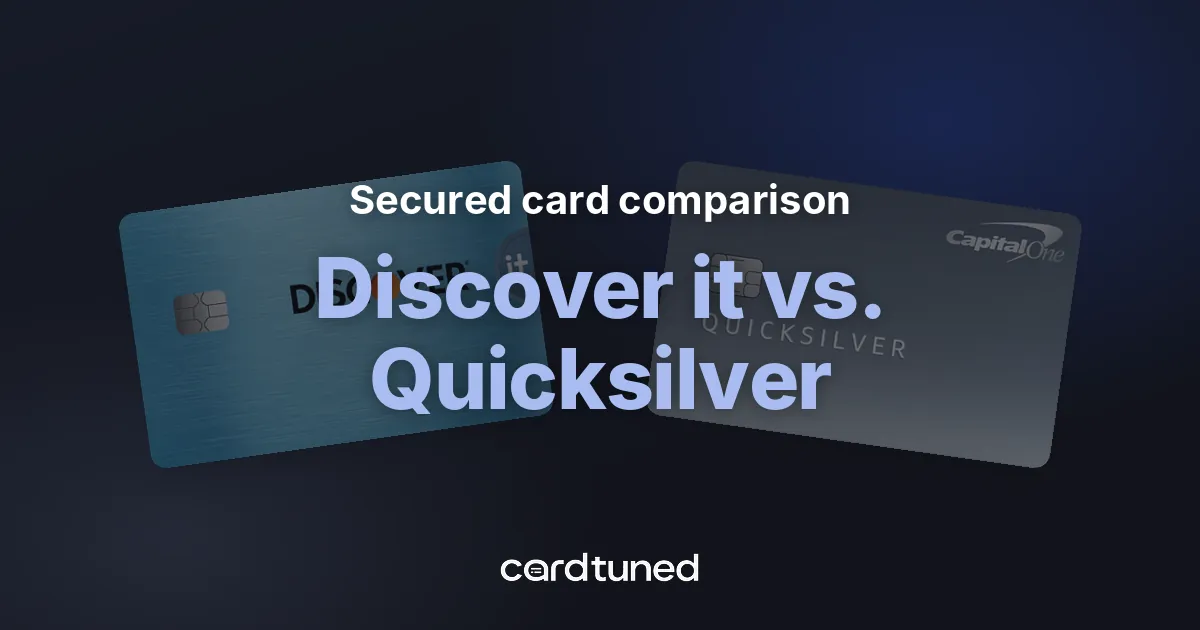
Comparing Discover it Secured vs. Quicksilver Secured starts with the cash you can set aside. If a $200 deposit would strain your budget, a secured card’s deposit matters more than its rewards headline. If that amount is comfortable, the next question is whether you want to manage rotating categories or use one everyday earning rate.
This comparison covers new-applicant offers checked October 25, 2026, including the application disclosures. Existing cardholders should use their own agreements; a newly advertised offer does not automatically change an older account.
For an existing Discover account, use the Discover-to-Capital-One migration checklist to follow your account notice and check sign-in and payments.
Compare the deposit and annual fee
| Decision factor | Discover it Secured Cash Back | Capital One Quicksilver Secured |
|---|---|---|
| Annual fee | $0 | $0 |
| Required deposit | $49, $99 or $200, based on creditworthiness | $200 minimum |
| Starting credit | At least $200 with the required deposit | At least $200 with the required $200 deposit |
| Everyday rewards | 5% in activated quarterly categories, subject to a quarterly cap; 1% otherwise | 1.5% on everyday purchases |
| Deposit return | Potential return as a statement credit when unsecured, or after closing and paying in full | Potential return as a statement credit with responsible use, or after closing and paying in full |
| Purchase / transfer / cash-advance APR | 29.24% variable for each | 29.24% variable for each |
Do not confuse the maximum with your starting limit. Both disclosures describe an assigned maximum between $1,000 and $3,000, subject to creditworthiness, and the option to deposit more before opening for a higher initial line. That is not an automatic $1,000 starting limit. [4] [2]
Sources: Discover application disclosure [4] and Quicksilver product and account terms [2]. A refundable deposit is collateral, not a fee or prepaid spending balance. You must fund it separately from monthly repayments.
What a lower deposit changes
Suppose you can set aside $250 without affecting essential expenses. A $49 deposit would leave $201 outside the account; a $99 deposit would leave $151; a $200 deposit would leave $50. These are budget illustrations, not predicted approvals. The lower deposit preserves cash only if that is the offer you receive.
If both offers require $200, the same $250 cash budget leaves $50 either way. Do not choose Discover on the assumption that the advertised lowest deposit will be your approved deposit.
Compare rewards on the same purchases
Discover’s official 5% calendar states a $1,500 quarterly purchase cap after activation; the secured product page confirms its rotating-category structure. Check the current eligible categories and your offer before applying. Beyond bonus eligibility, use the 1% rate rather than extending 5% to every purchase. [1] [3]
Compare how much of your normal spending actually earns the higher rate. A merchant that sounds like it belongs in a category is not enough; follow the program’s qualifying-purchase definitions.
A hypothetical $600 quarter
Assume $150 qualifies for Discover’s activated 5% category and $450 earns 1%. The same $600 earns Quicksilver’s everyday 1.5%. All purchases are paid in full; no fees, interest, returns or special booking-channel rewards apply.
Discover: ($150 × 5%) + ($450 × 1%) = $12.
Quicksilver: $600 × 1.5% = $9.
If none of the $600 qualifies for Discover’s bonus, rewards are $6 versus $9. The $3 difference is too small to justify extra purchases. This is spending accumulated across three months, not a $600 purchase on a $200 credit line.
For ordinary purchases in this simplified ongoing comparison, Discover breaks even when 12.5% of total spending actually earns 5%: 1% + (4% × qualifying share) = 1.5%. Count only activated, eligible purchases within the quarterly cap, not every purchase at a category merchant.
What happens above the cap?
For a separate hypothetical quarter with $1,800 entirely in eligible, activated categories, Discover earns ($1,500 × 5%) + ($300 × 1%) = $78, not $90. Quicksilver earns $27 at 1.5%. This illustration assumes enough actual available credit over time; it does not assume either card approves a particular limit.
Keep a low-limit account manageable by spreading only planned expenses over time and checking available credit before each purchase. Payment receipt and spending-room restoration are separate; do not depend on an immediate limit reset.
First-year value is separate. Discover matches eligible cash back earned during the first 365 days, with the match added within two billing periods afterward. Rewards processed after that period and closed accounts are excluded. This delayed promotion is not included in the ongoing examples. [4]
Both cards also have higher rates for certain Capital One booking channels. Those are excluded from the examples: compare the final booking price, eligible purchase type and channel terms separately. Discover’s activated-category terms require U.S. merchants and qualifying merchant codes. [4] [2]
Do not budget around an assumed upgrade date
Both product pages describe a path to getting the deposit back while keeping an account open, but the reviewed pages do not establish a guaranteed month for your upgrade. Discover describes becoming an unsecured Discover it Cash Back account; Capital One’s Quicksilver footnote says the account becomes unsecured and other features stay the same. [1] [2]
Ask what form the return takes. A statement credit reduces debt; it is not automatically cash arriving in your checking account. A higher credit limit and a returned deposit are also separate milestones. Do not plan an essential expense around either happening on a specific date.
The borrowing costs matter more than a small rewards gap
| Cost | Discover | Quicksilver |
|---|---|---|
| Annual fee | $0 | $0 |
| Cash advance | $5 or 5%, whichever is greater | $5 or 5%, whichever is greater |
| Balance transfer fee | None at the regular transfer APR; 5% for a promotional APR offer, if offered | None at the regular transfer APR; 4% for a promotional APR offer, if offered |
| Late payment | No fee the first time; then up to $41 | Up to $40 |
| Returned payment | Up to $30 | No separate returned-payment penalty listed; disclosure states no additional penalty fees beyond those listed |
The 29.24% variable APR shown above applies to purchases, transfers and cash advances in both reviewed offers. A transfer with no transfer fee can still accrue interest. Cash advances and transfers accrue interest from the transaction date. These are not advertised 0% borrowing offers. [4] [2]
A small interest charge can erase the rewards difference. For a simplified illustration, a $200 average balance at 29.24% for 30 days costs about $4.81 using $200 × 29.24% ÷ 365 × 30. Actual interest follows the account’s daily-balance calculation. Our rewards examples assume purchases are paid in full and no interest is incurred.
Choose one, or wait
- Consider Discover if the actual deposit offer preserves needed cash and category tracking fits your habits. Its main limitation is that the headline reward requires more attention than a flat rate.
- Consider Quicksilver if a $200 deposit is affordable and simplicity is worth more to you than occasional bonus-category gains. It can lose on rewards when enough ordinary purchases qualify for Discover’s bonus.
- Choose neither for now if the deposit would leave you unable to pay a normal bill. If you qualify for a suitable unsecured student card, compare that route before locking up cash.
Our student-card guide provides that broader starting point. Choose the account you can fund and manage consistently; treat rewards as a secondary benefit.
For a broader starting list, compare first-card options for someone with no credit history by eligibility, required cash and the account routine you can maintain.
Official sources
Product pages, application disclosures and cap checked October 25, 2026. Rates and offers can change. Examples are hypothetical and exclude first-year promotions unless expressly stated.