The Quick Answer
- Your own wages, salary, tips, commissions, bonuses and self-employment income can potentially count.
- Retirement income, interest, dividends, public assistance and certain support payments may also count.
- If you are 21 or older, an issuer may consider another person’s income if you have a reasonable expectation of access to it.
- If you are under 21, the rules are stricter. Simply having parents or a partner who can support you generally is not enough.
- Enter a good-faith number that matches the issuer’s instructions and the resources actually available to you—not the highest household number you can find.
First Check: Are You 21 or Older?
This is the most important dividing line in the federal credit-card ability-to-pay rules.
An issuer may consider income or assets belonging to another person when you have a reasonable expectation of access to them.
Examples can include regular deposits into a joint account, regular transfers into your account, or another person regularly paying your expenses.
The standard is stricter. The issuer generally needs information showing an independent ability to make the required payments.
Regular deposits into an account in your name can matter, but simply knowing that a parent could help you is not the same thing.
ILLUSTRATIVE CASE — Same household, different answer
Applicant A: Age 35. Her spouse’s paycheck is regularly deposited into a joint checking account both spouses use. That is the type of arrangement CFPB guidance recognizes as supporting reasonable access.
Applicant B: Age 35. His partner earns $100,000, but their finances are completely separate. He cannot use the partner’s account, receives no regular transfers and pays his own expenses. Living together does not make that $100,000 his accessible income.
What Income Can You Put on a Credit Card Application?
Regulation Z does not limit credit-card income to a traditional full-time salary. Employment can be full-time, part-time, seasonal, irregular, military or self-employment, and other legitimate income sources may also matter.
| Income source | Can it potentially count? | What to check |
|---|---|---|
| Salary or hourly wages | Yes | Current or reasonably expected |
| Tips, bonuses, commissions | Yes | Use a supportable amount; avoid speculative future pay |
| Freelance/gig income | Yes | Income attributable to you |
| Self-employment income | Yes | Do not confuse personal income with gross business sales |
| Interest and dividends | Yes | Current or reasonably expected |
| Pension/retirement benefits | Yes | Amount and likely continuation can matter |
| Social Security/public assistance | Potentially | Follow issuer instructions |
| Alimony/child support | Optional to disclose | You do not have to disclose it if you do not want it considered |
| Accessible spouse/partner income | Potentially | Age 21+ reasonable-access rule matters |
| Rental income | Potentially | Use income actually attributable to you |
| Scholarships/grants | Issuer-dependent | Especially whether funds remain available after school costs |
| Student loans | Only in limited circumstances | Only qualifying excess after amounts paid or owed to the school |
Employment status is not the same as income. A retiree may receive Social Security, a pension or investment income. Someone who is temporarily unemployed may still have legitimate resources an issuer can consider.
Can a Stay-at-Home Spouse Use Household Income?
Potentially, yes—especially when the applicant is at least 21. The key is not whether you personally receive a paycheck. It is whether you have a reasonable expectation of access to the income being considered.

ILLUSTRATIVE CASE — Stay-at-home spouse
One spouse earns $80,000, and both spouses use a joint checking account where the paycheck is regularly deposited. The stay-at-home spouse should not automatically assume their application income is $0 simply because they have no employment salary.
At the same time, marriage by itself is not the rule. Actual access is.
What Should Students Put for Income?
Being a student does not create a completely separate federal income definition. Age is the first thing to check.
Part-time wages, paid internships, work-study earnings, tips and freelance income can potentially be included. Parental support follows the age and access rules above.
Do Student Loans Count as Income?
Not automatically. CFPB commentary says student-loan proceeds may be considered current or reasonably expected income only to the extent that the proceeds exceed amounts disbursed or owed to the educational institution for tuition and other expenses.
ILLUSTRATIVE EXAMPLE — A $20,000 student loan is not $20,000 of income
Student-loan proceeds: $20,000
Amount disbursed or owed to the school: $16,000
The important number is not the original loan amount. If you cannot identify money remaining after amounts paid or owed to the school, do not simply assume part of the loan counts.
Scholarships and grants require similar caution. Some issuer guidance recognizes excess educational funds available after school expenses, but the application’s specific instructions matter.
If you are still choosing your first card, see CardTuned’s guide to credit cards for college students and our guide to first credit cards with no credit history.
What If You’re Self-Employed or Your Income Changes Every Month?
Self-employment, freelance and irregular income can potentially count. The harder question is how to turn uneven earnings into one annual number.
There is no single federal formula requiring every applicant to calculate variable income the same way. A practical approach is to use a representative historical period.
ILLUSTRATIVE EXAMPLE — Freelancer with uneven income
Six months of qualifying income: $3,000, $4,200, $3,700, $5,100, $3,400 and $4,600.
$4,000 × 12 = $48,000 illustrative annual estimate
This is a practical estimation technique, not a federal formula. If your business is seasonal or your circumstances recently changed, adjust accordingly rather than multiplying your best month by 12.
Gross Income or Take-Home Pay?
If the issuer asks for gross annual income, that generally means income before taxes and payroll deductions—not the amount that reaches your checking account.
ILLUSTRATIVE CASE — W-2 employee
Salary: $60,000
Take-home pay after taxes and deductions: $45,000
If the application specifically asks for gross annual income, the $60,000 salary is generally the relevant starting figure, subject to the issuer’s exact instructions.
What About Social Security, Retirement, Investments and Support Payments?
Having no job does not automatically mean having no income. Retirement benefits, interest, dividends and certain public-assistance income may potentially be considered. Regulation B also prevents creditors from automatically excluding income simply because it comes from sources such as part-time work or retirement benefits, although the creditor may evaluate the amount and probable continuation.
Alimony, child support and separate-maintenance income are different in one important way: if you do not want those payments considered in the credit decision, you generally do not have to disclose them.
Income You Should Be Careful About Reporting
- A partner or roommate’s salary you cannot use.
- Your parents’ full income simply because they sometimes help you.
- Gross business sales presented as personal income.
- One unusually strong freelance month multiplied by 12.
- A future salary you do not reasonably expect yet.
- A one-time payment presented as recurring annual income.
- The entire amount of a student loan.
- Money paid directly to a school that was never available for your living expenses.
Do Credit Card Companies Verify Income?
They can. Federal credit-card rules do not require every issuer to collect a pay stub or tax return from every applicant, and issuers may use information supplied on the application along with other underwriting information.
That does not mean the income field is ignored. An issuer can request additional information or delay an application while it verifies details. Enter a figure you can reasonably support rather than assuming it will never be reviewed.
What If Your Income Changes or You Enter the Wrong Number?
Income changes are normal. If your income was reasonably $65,000 when you applied and you later change jobs, that does not make the original figure retroactively inaccurate.
Variable income sometimes requires a reasonable estimate. That is different from knowingly entering a number that you do not believe reflects your income or accessible resources.
If you discover an actual error shortly after applying, contact the issuer and ask how it should be corrected. Existing cardholders may also be able to update their income later.
Before You Apply: Calculate Your Number in 7 Steps
- Start with your own income. Salary, wages, freelance income and other legitimate sources.
- Add other applicable resources. This may include investment, retirement, benefit or support income.
- Check your age. The rules change substantially below age 21.
- For age 21+, separate accessible income from household income. Do not add another person’s money simply because you live together.
- Estimate variable income reasonably. Use representative history rather than your best month.
- Read the exact application wording. Check whether the field says annual income, gross annual income or something else.
- Use a number you can support. The goal is accuracy, not maximizing the application number.
Bottom Line
- Employee: follow the issuer’s income wording and distinguish gross pay from take-home pay.
- Freelancer or business owner: use a supportable estimate of income attributable to you, not total business sales.
- Student or household-income applicant: check your age, actual access to the money and the issuer’s instructions before including another person’s income or educational funds.
Use a good-faith number you can explain. If the money is not available to you under the applicable rules, do not include it simply to increase the total.
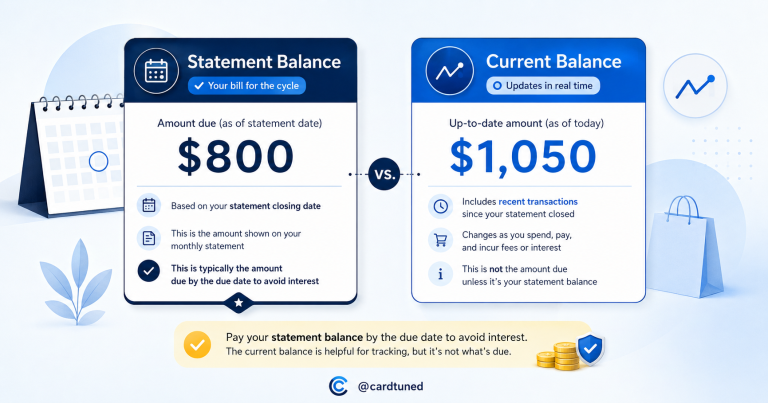
After you open a card, the next important payment concept is understanding the difference between your statement balance and current balance.
Editorial update — October 11, 2026: Reading order, labels and layout reviewed. This is not a new verification of the underlying income rules; the source and verification notes retain their stated scope.