Initial review: September 4, 2026. Payment-display and Capital One AutoPay guidance updated October 6, 2026.
You open your credit card app and see three numbers: an $800 statement balance, a $1,050 current balance, and a $40 minimum payment. The confusing part is that all three are correct—but they answer different questions.
For most cardholders, the practical question is simple: How much do I need to pay to avoid interest without paying next month’s purchases early?
4 Things to Remember
- Statement balance: usually the key number for paying the last billing cycle in full.
- Current balance: a more up-to-date total that can include newer purchases.
- Minimum payment: helps you avoid a late payment, but usually does not avoid interest.
- Main exception: if you are already carrying an interest-bearing balance or have lost your grace period, the simple statement-balance rule may no longer eliminate all interest.
Short answer: If your card has a grace period on purchases and you have maintained it, paying the full statement balance by the payment due date is generally enough to avoid purchase interest. You normally do not need to pay the entire current balance because it may include purchases made after the statement closed.
Statement Balance vs. Current Balance: Quick Comparison
| Balance | What it means | What it usually means for payment |
|---|---|---|
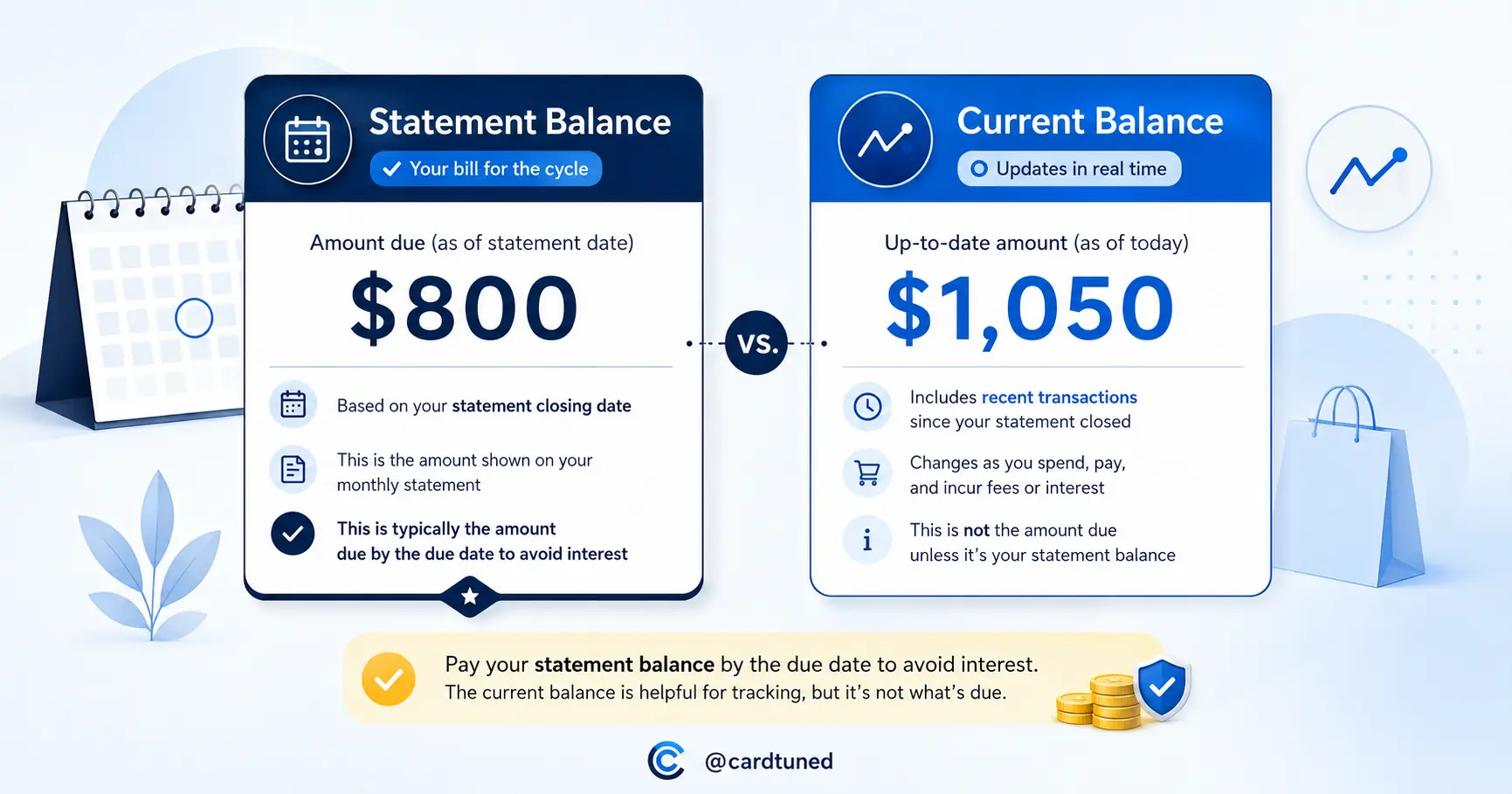
| Statement balance | Amount owed when the latest billing cycle closed | Usually the amount to pay in full by the due date if the grace period applies |
| Current balance | More recent total reflecting posted activity since the statement closed | May include purchases from the next billing cycle |
| Minimum payment | Smallest required payment shown on the statement | Helps keep the account current, but can leave interest-bearing debt |
Why Are the Statement Balance and Current Balance Different?
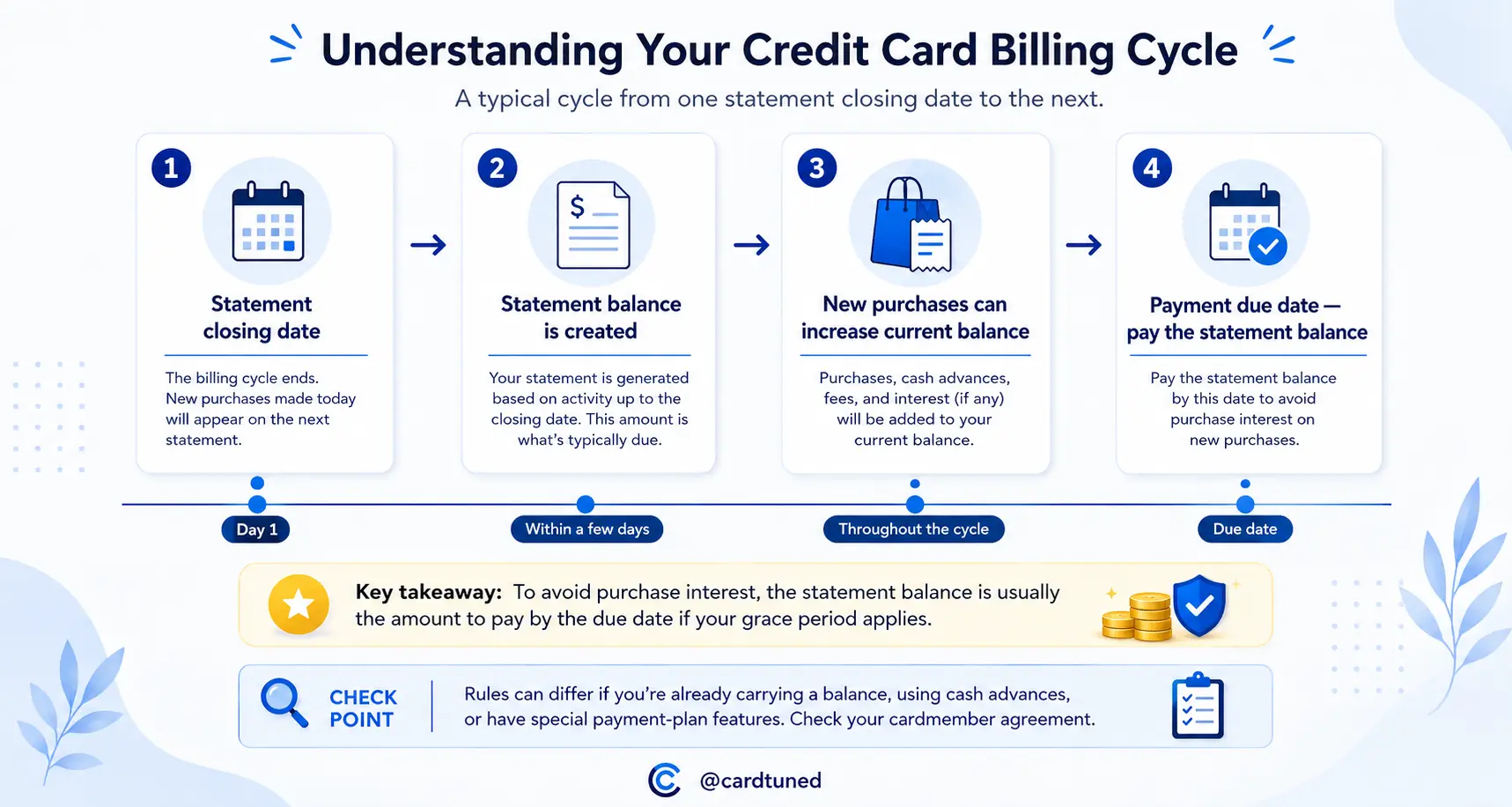
The easiest way to understand the two balances is to think of the statement balance as a snapshot and the current balance as a live total.
Your statement balance is created when the billing cycle closes and generally remains the historical total for that cycle. Your current balance keeps changing as new posted activity appears.
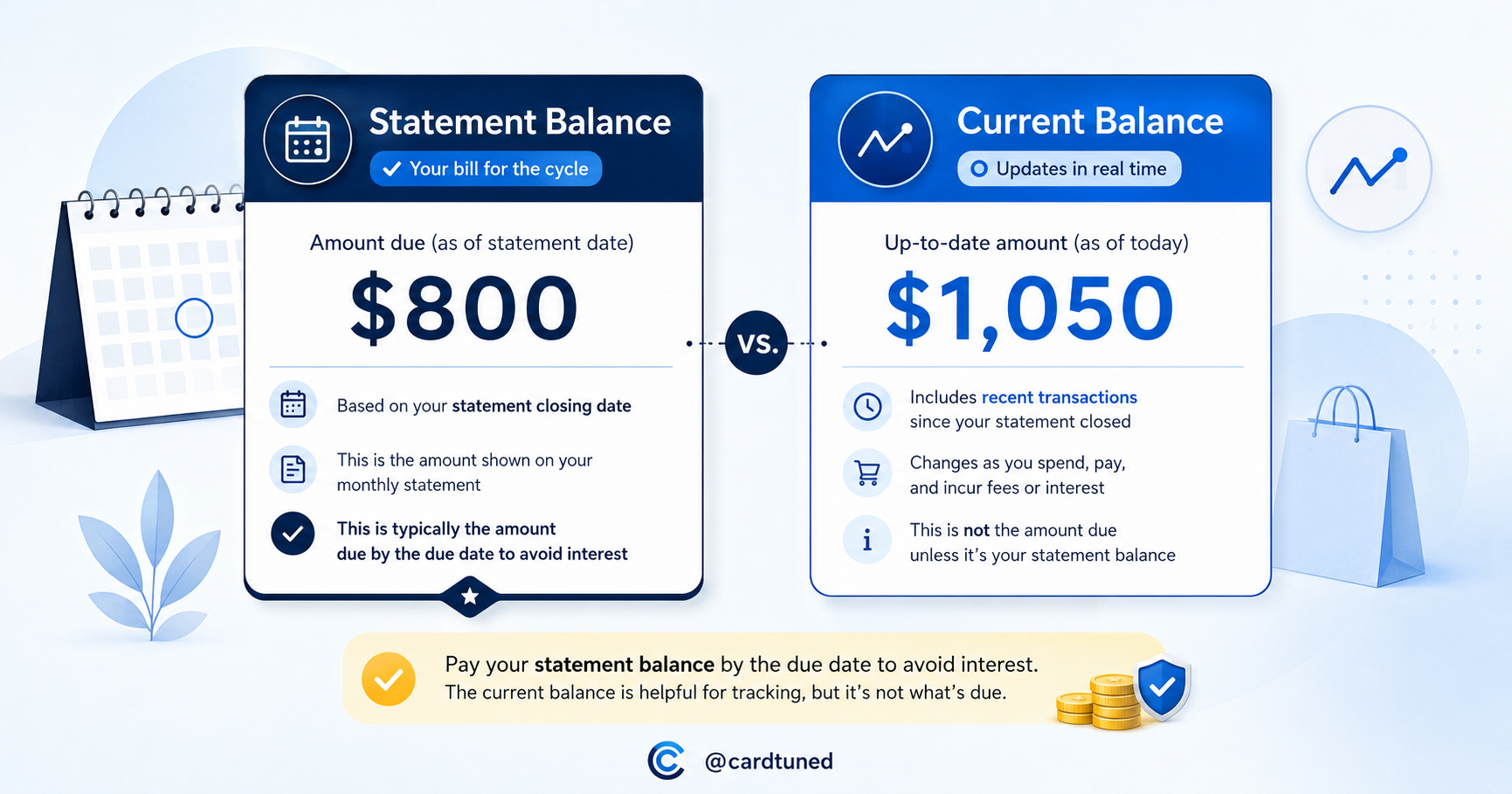
If your statement closes at $800 and another $250 of purchases posts afterward, your current balance may become $1,050 while the statement balance stays at $800. Payments, refunds, and credits can lower the current balance. Pending transactions may be shown separately. Capital One says its pending transactions reduce available credit but are not included in the account balance until they post, and issuer displays can vary.
So Which Balance Should You Normally Pay?
If you still have an applicable grace period on purchases and you are not already carrying an interest-bearing purchase balance, the full statement balance by the due date is usually the practical answer.
The CFPB explains that when a card offers a grace period and you are not carrying a balance, paying the balance in full by the due date can prevent interest on new purchases. You do not normally have to prepay purchases that posted after the statement closed.
Key takeaway: In most cases, pay the statement balance if your goal is to avoid purchase interest. The current balance is useful for tracking what you owe right now, but it is not automatically the amount due.
When Does Paying the Current Balance Make Sense?
Paying the current balance simply means paying ahead. It can make sense when:
- You want more available credit. Paying newer posted purchases can restore room under your credit limit.
- You prefer a near-zero card balance. Some people find that easier for budgeting.
- You are already paying interest. Earlier payments can reduce the balance on which more interest may accrue.
- You want to reduce the balance that may be reported. An early payment can sometimes lower reported utilization, but issuer reporting dates vary and no payment schedule guarantees a particular credit-score result.
The last point is easy to confuse with interest avoidance. Managing credit utilization and preserving a grace period are two different goals.
Why Is the Minimum Payment Not Enough?
The minimum payment is mainly about meeting the required monthly payment. It is not usually the amount needed to pay the billing cycle in full.
Regulation Z §1026.7(b)(12)(i)(A) requires qualifying credit card statements to warn consumers that paying only the minimum means paying more interest and taking longer to repay the balance.
If your statement balance is $800 and your minimum payment is $40, paying $40 may satisfy the minimum obligation for the month, but most of the $800 remains unpaid. If the remaining amount is subject to a regular purchase APR, interest can become part of the cost.
If a medical bill would take multiple statements to pay, compare credit cards for medical expenses and build a payoff plan before charging it.
Important: Minimum payment and interest-free payment are not the same thing. The minimum helps keep your account current. The statement balance is usually the better target when you want to avoid purchase interest.
CHECK POINT: When the Simple Rule Can Break
Do not apply “just pay the statement balance” to every account. Check these exceptions first.
1. You are already carrying an interest-bearing balance
If you did not previously pay the required balance in full, you may lose the purchase grace period. CFPB guidance explains that interest can then apply to the unpaid balance and new purchases may begin accruing interest from the date of purchase.
2. Residual or trailing interest is still accruing
Interest can continue between the statement date and the date your payment is received. Chase explains that this residual interest can appear on the next statement. If you are trying to fully pay off an account that is already accruing interest, the printed statement balance may not be the exact payoff amount.
3. The transaction is not a normal purchase
Cash advances generally do not receive the same grace period as purchases. Balance transfers, promotional APRs, deferred-interest arrangements, and installment or payment-plan features can also follow separate rules.
4. A payment is returned or account activity changes
A returned payment can reverse a payment and may trigger fees or other consequences. Refunds, credits, and pending activity can also change what the app displays. Your account terms control when they differ from a general example.
Statement Closing Date vs. Payment Due Date
The statement closing date ends a billing cycle and creates the statement balance. The payment due date comes later and is the deadline for the required payment shown on that statement.
Federal rules generally require issuers to have procedures designed to deliver periodic statements at least 21 days before the payment due date. More precisely, this timing rule appears in §1026.5(b)(2)(ii)(A).
Purchases that post after the statement closes generally belong to the next cycle, which is why a higher current balance does not automatically mean you are behind.
To understand which balance may reach your credit report, read our guide to credit utilization, statement dates and due dates.
How Should You Set Up AutoPay?
If you routinely pay purchases in full and keep enough money in the linked bank account, AutoPay for the statement balance is often the simplest default.
After a manual payment, review the next scheduled withdrawal. Capital One says payments made before AutoPay processes reduce its upcoming minimum-payment or statement-balance AutoPay amount. Other issuers may handle this differently, so verify the scheduled amount rather than assuming AutoPay was canceled.
Check the label your issuer uses. Capital One offers minimum-payment, statement-balance, and fixed-payment AutoPay choices. Features such as American Express Plan It or Chase Pay Over Time can change what your payment screen shows or how your balance is presented, so review what the selected option covers and keep enough money in the funding account.
AutoPay tip: If you want the simplest “set it and forget it” setup, statement-balance AutoPay is usually the best fit for someone who pays in full each month and keeps enough cash in the linked checking account.
Three Examples That Make the Difference Clear
Example 1: $800 statement balance, then $250 in new purchases
Assume you have maintained your grace period. Your statement closes at $800. Afterward, $250 in new purchases posts, making the current balance $1,050.
Normal result: Paying the $800 statement balance by the due date would generally pay the completed billing cycle in full. The extra $250 would normally belong to the next cycle.
Example 2: You pay before the statement closes
Your current balance is $900 several days before closing. You pay $400 and no other transactions post. The statement balance could therefore close at about $500. That early payment may also affect the balance later reported to credit bureaus, depending on issuer timing, but it does not guarantee any specific credit-score result.
Example 3: You are already paying interest
Your statement shows $1,200, but you previously lost the grace period. Interest keeps accruing after the statement closes. Paying exactly $1,200 on the due date may not permanently bring the account to zero because more interest may have accrued. Here, paying sooner or getting current payoff information matters more than choosing between the two balance labels.
3-Line Decision Guide
1. Pay the statement balance when you normally pay in full and your purchase grace period applies.
2. Consider paying the current balance when you want to pay ahead, free up credit, or reduce an interest-bearing balance sooner.
3. Check your issuer instead of relying on either number when you are carrying a balance, using a cash advance or balance transfer, on a special payment plan, or trying to fully pay off an interest-bearing account.
The useful rule is not “always pay the current balance” or “always pay the statement balance.” It is: know whether your grace period applies. If it does, the full statement balance by the due date is usually the number that matters.
Frequently Asked Questions
Does paying the statement balance count as paying in full?
For a typical purchase balance with an applicable grace period, paying the full statement balance by the due date generally satisfies that billing cycle in full. Accounts that have lost the grace period or use special financing features may work differently.
Can my current balance be lower than my statement balance?
Yes. Payments, refunds, credits, and other activity after the statement closes can reduce the amount currently owed while the original statement balance remains visible as a historical snapshot. If you already paid, check that the payment posted successfully and review the remaining statement amount due before paying again. An unchanged historical statement balance alone does not mean you still owe that amount. Do not assume a refund or rewards credit satisfies your minimum payment; check your issuer’s rules.
New to credit cards and currently in college? See CardTuned’s guide to the best credit cards for college students.
Sources and Methodology
CardTuned reviewed current CFPB Regulation Z guidance and official issuer documentation covering billing balances, grace periods, minimum-payment disclosures, pending transactions, AutoPay, residual interest, and issuer-specific payment-plan balances. Account terms vary, so your cardholder agreement and monthly statement control when they differ from general examples.
- CFPB — Credit card grace periods
- CFPB — Regulation Z §1026.5
- CFPB — Regulation Z §1026.7
- Capital One — Statement balance vs. current balance
- Capital One — Pending transactions
- Capital One — AutoPay
- Chase — Residual interest
- American Express — Types of balances
- American Express — Plan It FAQ
Initial review: September 4, 2026. Targeted payment-display and Capital One AutoPay update: October 6, 2026.