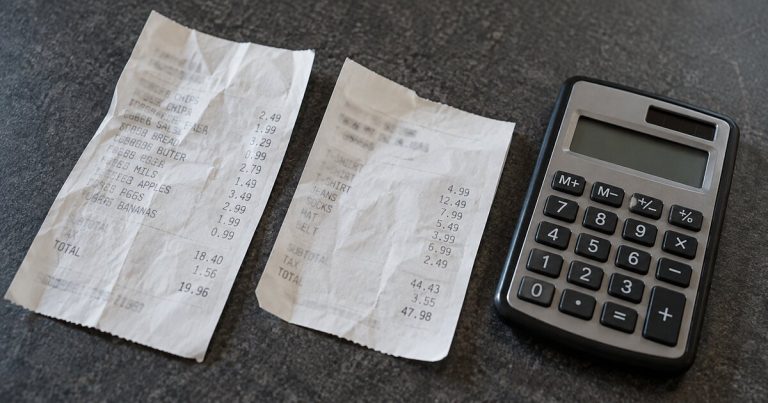
A 5% cash back cap limits the spending that earns the bonus rate. You have spent enough to earn the full category bonus. Then another grocery bill, online order or gas purchase arrives. Does the next charge still earn 5%?
To put the fallback into a full wallet plan, see our one-card vs. two-card break-even calculation. Check which grocery purchases qualify before tracking a supermarket cap.
The answer depends on your card’s terms. A cap can limit the spending eligible for the elevated rate without stopping ordinary rewards. The useful next step is to identify the rate on your next purchase, not average together the rewards you already earned.
What a Cash Back Cap Actually Limits
Read the unit first. “Up to $1,500 in purchases” describes eligible spending, not $1,500 in rewards. At 5%, that spending produces $75. A separate offer described as a maximum dollar amount of bonus rewards would require a different calculation.
Then identify the pool. A limit might cover one category or several categories together. Your personal grocery budget is not the same thing as the issuer’s eligible-spending total.
For a concrete example, Freedom Flex’s product terms describe 5% on up to $1,500 in combined quarterly-category purchases after activation. Its separate ordinary categories matter after that limit: qualifying dining and drugstore purchases earn 3%, eligible Chase Travel purchases earn 5%, and other eligible purchases earn 1%. See the linked terms for additional or temporary offers. “The cap was reached” therefore does not mean every later purchase earns the same rate.
Why Your Real Return Can Be Below 5%
For the following model, assume a single category pays 5% on the first $1,500 and 1% afterward. All spending in the table is eligible, there are no overlapping bonuses, and the cap starts unused.
| Total spending | Bonus-tier rewards | Overflow rewards | Total rewards | Blended rate |
|---|---|---|---|---|
| $1,000 | $50 | $0 | $50 | 5.00% |
| $1,500 | $75 | $0 | $75 | 5.00% |
| $2,000 | $75 | $5 | $80 | 4.00% |
| $3,000 | $75 | $15 | $90 | 3.00% |
| $4,500 | $75 | $30 | $105 | 2.33% |
The blended rate is total rewards divided by total spending. It describes the period as a whole; it does not tell you which card to use for the next purchase. At $2,000 of spending, the blended return is 4%, but the next dollar in this model still earns only 1%.
Total rewards = 0.05 × min(spending, $1,500) + 0.01 × max(spending − $1,500, $0).
Replace the cap and rates with the terms for your own card.
When Does a 2% Fallback Make Sense?
Once the first card falls to 1%, an eligible 2% fallback adds one cent per dollar. The benefit is easy to calculate: overflow spending multiplied by one percentage point.
With $3,000 of eligible spending, keeping everything on the modeled card earns $90. Splitting the budget into $1,500 at 5% and $1,500 at 2% earns $105. The two-card approach adds $15. Compared with putting the entire budget on a 2% card, it adds $45.
Those are different comparisons. The first measures the value of changing cards after the cap; the second measures the value of using the category card at all. Mixing them can make an extra card look more valuable than it is.
A fallback only helps if its transaction is eligible and the added return exceeds any new costs. An existing no-extra-cost card can make switching simple. A new annual fee, payment surcharge or unnecessary purchase can erase a small advantage.
What About a Purchase That Crosses the Cap?
Suppose the cap is $1,500, eligible spending stands at $1,460, and you make a $100 purchase. Under a model that allocates rewards across the threshold, $40 earns 5% and $60 earns 1%, for $2.60 total. It is neither $5 nor $1.
This is an illustration of split-tier arithmetic, not a promise about every issuer’s implementation. Check the program terms and the posted rewards detail for rounding and allocation. If you cannot see exactly how much capacity remains, a small estimate error is usually less important than avoiding a fee or unnecessary spending.
Quarterly, Annual and Billing-Cycle Caps Are Different
Do not build a reminder until you know the reset period. A quarterly allowance and an annual allowance need different tracking. A billing-cycle cap, when specified by the issuer, follows a statement cycle rather than an assumed calendar month.
For contrast, Blue Cash Preferred’s rewards guide specifies 6% on up to $6,000 of eligible U.S. supermarket purchases per calendar year, then 1%. The period is January through December, not your account anniversary. This is an example of a reset rule, not a recommendation to acquire the card.
Do not assume that paying the balance replenishes a rewards cap. A payment reduces what you owe; a spending allowance is governed by the rewards program. Likewise, check how returns affect the issuer’s displayed total instead of treating a refunded purchase as instantly restored capacity.
Does unused capacity roll over? Do not assume it does. Check your program’s reset and rollover language; unused spending capacity is different from rewards already earned. If the post-cap rate is unclear, confirm it in the rewards agreement before choosing a fallback.
A Tracking Routine That Takes Less Effort
- Record the exact rule. Note the cap, period, categories, activation requirement and post-cap rates.
- Use the issuer’s rewards total. A budgeting app’s category may not match rewards eligibility.
- Set an early checkpoint. For a $1,500 allowance, checking around $1,200 leaves time to choose the fallback.
- Review posted transactions. Pending purchases and later adjustments can make your own estimate differ.
- Recheck at the reset. Confirm the new categories and any activation step before switching back.
The Bottom Line
A capped card can still be useful after the advertised rate ends, but it must compete on the rate that applies now. Track the allowance, compare the next dollar, and keep the setup simple enough to use consistently.
For a current worked example, read the Chase Q4 grocery analysis. For a category cap to matter, the purchase must qualify first; verify the merchant category before counting it toward your allowance.
A cap is one part of the choice. Return to the grocery-and-dining card comparison to weigh eligible spending, the annual fee and the rate on purchases outside the bonus category.
Methodology and Sources
Tables and thresholds are original arithmetic using stated hypothetical rates. Examples exclude welcome bonuses, interest, fees, refunds, special redemptions and overlapping categories unless expressly stated. The 2% fallback is an assumption, not a product recommendation. Reward optimization should not require purchases outside your budget. This article is educational, not individualized financial advice.