Denied a student credit card? The useful next step depends on the reason: a reporting error needs a dispute, missing information needs clarification, and an affordability problem needs a different plan. Applying for another card before identifying that reason can leave the original problem untouched.
1. Find the denial notice and its deadlines
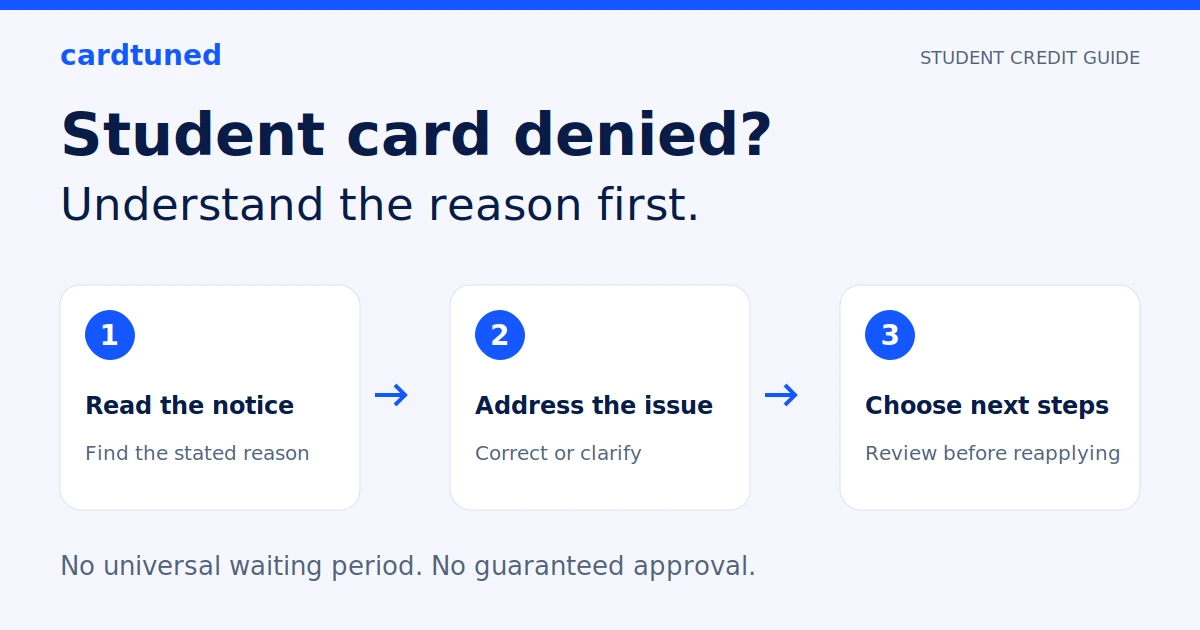
The CFPB says the lender must provide the main reasons for denying credit or explain how to request them within 60 days. If a credit report was used, the notice identifies the reporting company and explains your right to request a free report from it within 60 days of the notice. [1]
Keep the notice, application date and reference number. Use the actual reason the issuer gives; a score from a monitoring app is not a substitute for that explanation.
| Reason or issue | Useful next action |
|---|---|
| Unfamiliar debt or incorrect late payment | Dispute the inaccurate item with the bureau and furnisher. Keep evidence; confirm the outcome and what the updated report shows before relying on a correction. |
| Information could not be verified | Ask which field or document is missing, where to submit it securely, the deadline, and whether the existing application can remain open for review. |
| Income or obligations | Correct any honest reporting mistake using the application instructions. If the information is accurate, reassess affordable repayments; do not inflate income or assume a deposit solves the issue. |
| Limited credit history | Check a product designed for a limited credit file. A secured alternative still requires approval and cash for a deposit; no fixed waiting period guarantees success. |
| Student eligibility | Confirm the product’s enrollment definition. If you do not qualify, compare an appropriate nonstudent product instead of resubmitting the same ineligible application. |
2. Fix report errors through the dispute process
Request the report identified in the notice and inspect the account details, payment history and identity information. The CFPB advises disputing inaccuracies with both the credit reporting company and the company that furnished the information. The reporting company must investigate and correct errors it finds. [1]
Same rejection, different next step
Two hypothetical students receive rejection notices. Alex finds a late payment on an account that is not theirs; the next task is resolving the reporting problem. Jordan’s report is accurate, but the notice points to insufficient income relative to obligations; the next task is understanding the budget and application requirements.
The next step follows the reason in the notice. Neither student has a guaranteed approval date.
3. Check income rules without inflating the number
Regulation Z requires issuers to consider ability to make minimum payments based on income or assets and current obligations. Applicants under 21 generally need independent ability to pay, or a qualifying cosigner, guarantor or joint applicant aged 21 or older who assumes liability; a particular issuer need not offer that route. [2]
For applicants 21 or older, an issuer may consider income reasonably accessible to them, but may instead require independent income. Follow the application’s actual instructions. Being a student is not an exemption from repayment requirements. [2]
Do not add a parent’s full salary just to make the application look stronger. Ask what income is eligible for your age and circumstances. Clarifying a misunderstanding is different from changing a truthful answer to obtain approval.
4. Ask whether the existing application can be reviewed
Contact the issuer through its official application-support channel. Ask: “Can you clarify this reason, and can corrected information be reviewed on this application?” Ask whether a new application or credit inquiry would be required. Do not assume every issuer offers reconsideration.
Before another application, check three things
- Reason understood: you can name the issue in the notice.
- Relevant change confirmed: the report, document, budget or product eligibility problem has been addressed.
- Next route chosen: the issuer has explained whether it can review the existing application or needs a new one, and whether a new credit inquiry is involved.
If the issue is product fit, our student-card guide can help you compare options. A secured card is not an automatic approval: Capital One confirms that applicants can be declined. [3] If the budget cannot support another bill, waiting is a reasonable outcome.
Official sources
Sources checked October 24, 2026. Account terms can change. Examples are hypothetical.